
Essential Purchase Order Checklist for Buyers
Purchase order checklist
A purchase order (PO) is the document in which a buyer asks a vendor for goods or services at a stated price. Use this checklist before you send a PO:
| Section | Item | Notes |
|---|---|---|
| Header | Unique PO number | Never skip or reuse a number, also for a cancelled PO |
| Header | Date of issue | |
| Header | Buyer’s legal name, address and contact person | |
| Vendor | Vendor’s legal name, address and contact | Use the registered legal name, not a trade name only |
| Vendor | Vendor ID or tax ID from your vendor list | |
| Reference | Quote number, contract number or project code | Connects the PO to the agreed price |
| Line items | Item number (vendor SKU, part number or your internal code) | One line for each item |
| Line items | Full description, quantity and unit of measure | For example “case of 10 reams”, not “paper” |
| Line items | Unit price and line total | Line total = quantity × unit price |
| Totals | Subtotal, shipping, tax and PO total | Make sure that the numbers add up |
| Terms | Payment terms and currency | For example Net 30 |
| Terms | Shipping terms | Who pays freight and when ownership passes |
| Delivery | Ship-to address and contact at that address | Make sure that the address is current |
| Delivery | Required-by date | A date, not “as soon as possible” |
| Delivery | Delivery instructions | Dock, liftgate, signature, delivery hours |
| Internal | Budget code or cost center | If your accounting system needs it |
| Internal | Approver name and approval date | Follow your approval limits |
| Services | Rate, estimated hours, deliverables and a maximum amount | For a PO for services |
When a purchase order becomes binding
A PO is an offer to buy. It becomes a contract when the vendor accepts it. In the US, the Uniform Commercial Code covers sales of goods. Under UCC section 2-206, a vendor can accept an order for prompt shipment in two ways. The vendor can promise to ship promptly, or it can ship the goods.
After acceptance, the PO is evidence of what both sides agreed. If the PO has the wrong address or no delivery date, you have less to point to in a dispute. Contract law differs between countries and for services. For a large or unusual order, ask your legal team which terms apply.
Payment terms
Write the payment terms on every PO. These are the usual forms:
- Net 30: the buyer pays the full amount within 30 days of the invoice date. Net 60 gives 60 days.
- 2/10 Net 30: the buyer can take a 2% discount for payment within 10 days. Otherwise, the full amount is due in 30 days.
- Due on receipt: the buyer pays when the invoice arrives.
Make sure that the terms on the PO are the same as the terms in the quote or the contract. If they are different, the invoice and the PO will not match, and the payment will wait.
Line items
The line items tell the vendor exactly what to ship. Make each description specific enough that a stranger can pick the correct item from a shelf. “Office supplies” is too vague. “Stapler, Swingline 747, black” is specific.
These are the details that prevent the wrong item:
- Brand, model or part number
- Size, color, grade or weight
- Unit of measure (each, box, case, pallet) and the number in each unit
- Required certifications or standards, if your industry needs them
For example, “copy paper” can arrive as the wrong weight. “Copy paper, 8.5 x 11, 24 lb, 10 reams per case” cannot.
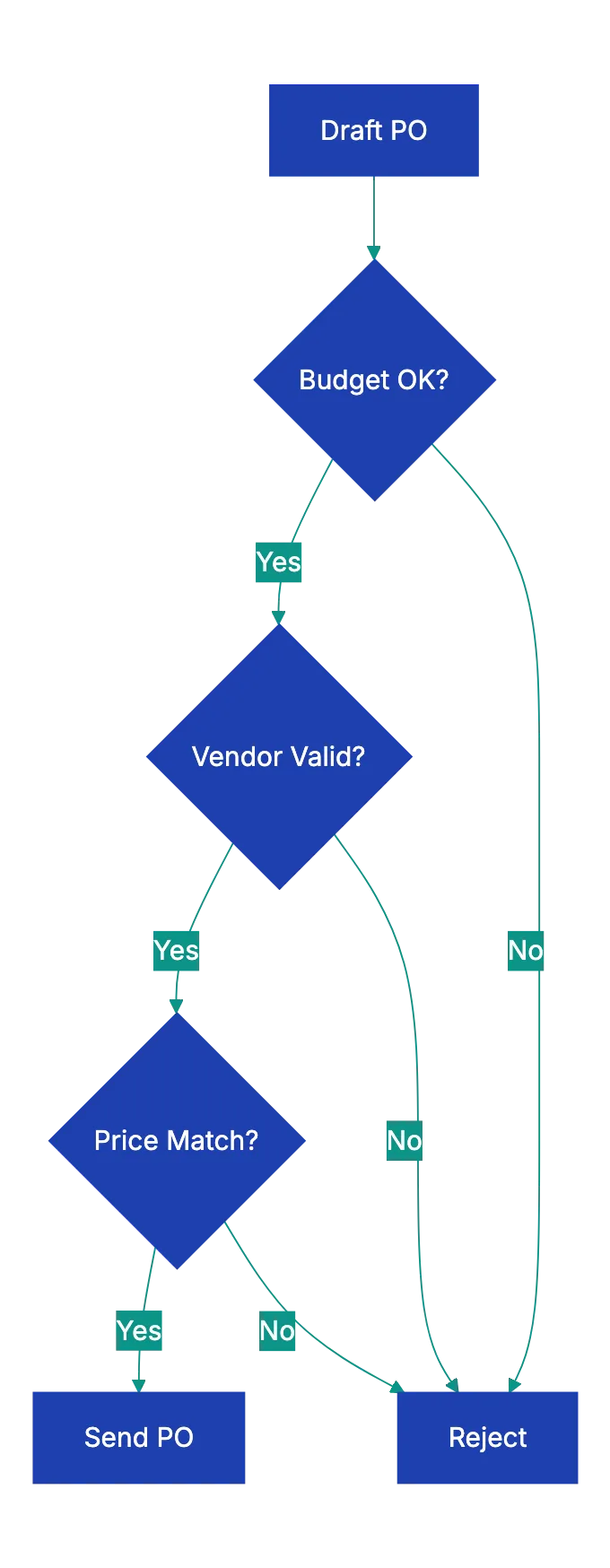
Before you send the PO
- Make sure that the budget is available and approved for this purchase.
- Make sure that the approver has the authority for this amount under your approval limits.
- Compare the vendor’s legal name, address and tax ID with your vendor list.
- If the vendor’s address or bank details changed by email, call the vendor at a number that you already have.
- Open the quote or the contract. Make sure that each unit price on the PO agrees with it.
- If the quote has expired, get a new price from the vendor before you send the PO.
- Multiply quantity by unit price for each line. Make sure that the line totals, shipping and tax add up to the PO total.
- Make sure that the ship-to address is current and that the required-by date is realistic.
- Add the delivery instructions, for example dock delivery, liftgate or signature.
Common purchase order errors
| Error | Result | Prevention |
|---|---|---|
| Vague description | The vendor ships an item that matches the words but not your need | Add brand, model, size and unit |
| Old ship-to address | Goods go to a closed site or to the wrong site | Make sure that the address is current on every PO |
| Expired quote | The vendor invoices at a higher price | Get a new price before you send |
| No required-by date | The vendor ships when it is convenient for the vendor | Always add a date |
| Decimal error in a line total | The invoice does not match the PO, and payment waits | Recalculate each line |
| Vendor with a similar name | The PO and the payment go to the wrong company | Match the tax ID with your vendor list |
| Blanket PO with no release schedule | The vendor ships everything at once | Attach the delivery schedule |
| Service PO with only a maximum amount | The vendor bills hours up to the maximum but delivers less work | Add rates, deliverables and milestones |
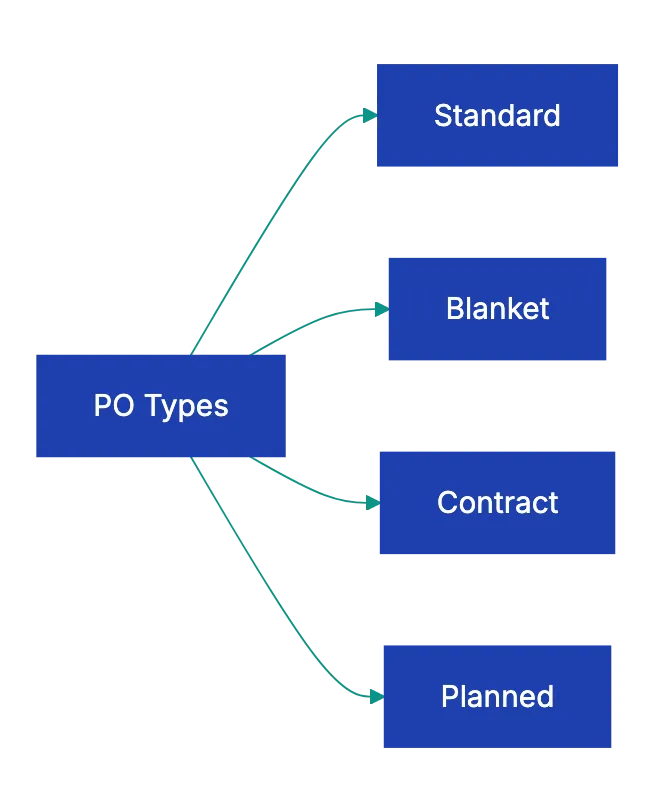
Purchase order types
| Type | Use it for | What it must also show |
|---|---|---|
| Standard | One purchase with a known item, quantity and date | The full checklist above |
| Blanket | Repeated purchases from one vendor over a period, up to a maximum amount | The period, the maximum amount, how you release orders and the invoice schedule |
| Contract | Orders under a contract that sets prices and terms | A reference to the contract, plus quantity, date and ship-to address for this order |
| Planned | Large items with staged deliveries or staged payments | Each delivery date and the payment for each milestone |
Changes after you send a PO
If you must change a PO after you send it, issue a revision of the same PO. For example, change PO-1001 to PO-1001 Rev A. Do not issue a new PO number. Write down what changed and when. Get the vendor’s acceptance of the revision. Then receiving and accounts payable know which version is current.
Use this checklist with Claude or ChatGPT
Claude or ChatGPT can do a first pass on a PO draft. Paste the checklist into the chat. Then paste or attach the PO and, if you have it, the vendor’s quote. Ask the AI to compare them:
Below is my purchase order checklist, a draft PO and the vendor's quote.
Go through the checklist item by item and say whether the PO has it.
Compare every unit price, quantity and term on the PO with the quote.
Recalculate each line total and the PO total. List every missing
item and every difference.
Do not send the PO based on the AI answer alone. The AI can make arithmetic errors or report a difference that is not there. Recalculate the totals yourself and find each reported problem in the documents. Remove bank details and personal data that the AI does not need before you upload. Make sure that your company permits you to share vendor prices with an AI tool.
A docs portal with Ask AI
and support tickets
Connect a repository, or describe your product to start. Each docs site has search, Ask AI, an API console, an MCP server and support tickets.
- Publishes from GitHub on every push
- Works with Mintlify repositories
- API console from your OpenAPI file
- MCP server and llms.txt for AI agents
- Ask AI and support tickets
- Analytics for people and AI agents
Frequently Asked Questions
What is the difference between a purchase order and an invoice?
The buyer issues the purchase order before the purchase. It states what the buyer wants, at what price and by when. The vendor issues the invoice after it delivers. The invoice asks for payment and refers to the PO number. Accounts payable compares the two before it pays.
What is three-way matching?
Three-way matching is a payment control. Before accounts payable pays an invoice, it compares three documents. These are the purchase order, the receiving report (what arrived) and the vendor’s invoice. If the item, the quantity and the price are the same on all three, the invoice is approved for payment. If they are different, someone must find the cause first.
Related Articles

Essential Resume Screening Checklist for Employers
A resume screening checklist for employers: criteria to set first, two review rounds, a scoring table and the US legal rules to follow.

Essential Job Offer Letter Checklist for Candidates
A job offer letter checklist for candidates and HR: pay, bonus, equity, benefits start dates, legal terms, and red flags to ask about before you sign.

Essential NDA Review Checklist and Tips
An NDA review checklist: parties, the definition of confidential information, duties, time limits, remedies, hidden restrictions and US legal limits.