
Essential Job Offer Letter Checklist for Candidates
Table of Contents
- Introduction
- Why Offer Letter Details Matter More Than You Think
- Breaking Down Compensation Language That Actually Makes Sense
- Benefits That Look Good Until You Read the Fine Print
- Legal Language That Protects Everyone (When Done Right)
- Red Flags for Candidates Reviewing Offers
- Common Mistakes Employers Make Writing Offer Letters
- How Document Review Tools Catch What Humans Miss
- Final Thoughts
- Introduction
- Employment Offer Letter Template Checklist
- Essential Position Details
- Compensation and Payment Terms
- Benefits Package Details
- Legal Terms and Conditions
- Response and Acceptance Requirements
- Why Offer Letter Details Matter More Than You Think
- Breaking Down Compensation Language That Actually Makes Sense
- Benefits That Look Good Until You Read the Fine Print
- Legal Language That Protects Everyone (When Done Right)
- Red Flags for Candidates Reviewing Offers
- Common Mistakes Employers Make Writing Offer Letters
- How Document Review Tools Catch What Humans Miss
- Final Thoughts
Introduction
Receiving a job offer feels thrilling, but between the thrill and signing day, there’s important work to do. A thorough job offer letter checklist protects both the employer drafting it and the candidate reviewing it. Missing details create confusion about compensation, benefits start dates, or even what job you’re accepting. For HR teams, incomplete letters miss offer letter requirements and expose the company to legal risk and employee disputes down the road.
For candidates, they leave important questions unanswered. This offer letter checklist details everything a complete offer letter should include, highlighting what should be in an offer letter, whether you’re writing one or deciding whether to accept one. Use this as a pre-signing quality control filter.
Copy this checklist and paste it into Revdoku’s Generate Checklist to review your documents automatically:
Job Offer Letter Checklist for Candidates

You are an employment attorney reviewing workplace agreements and offers for essential terms, legal compliance, and employee protections. Check each requirement independently.

- Candidate's full legal name (exactly as it appears on employment documents)
- Exact job title matching the position  they interviewed for
- Department and reporting manager's name and title
- Official start date (month, day, year)
- Work location: office address, remote, or hybrid with required in-office days specified
- Employment type: full-time, part-time, temporary, or contract
- FLSA classification: exempt or non-exempt status clearly stated
- Base salary stated as annual amount OR hourly rate clearly labeled
- Pay frequency specified (weekly, bi-weekly, semi-monthly, monthly)
- Bonus structure if applicable: target amount and calculation method
- Commission plan details if applicable: rates, calculation, payment schedule
- Equity or stock options: number of shares/options granted
- Vesting schedule for equity: timeline and cliff period if any
- Strike price for stock options if applicable
- Signing bonus amount and any repayment/clawback conditions
- Health insurance coverage and effective date (immediate, 30, 60, or 90 days)
- Dental and vision insurance availability and start date
- Retirement plan details (401k, 403b) and employer match percentage
- PTO policy: vacation days, sick days, personal days specified
- PTO accrual method: lump sum at start or monthly accrual
- Paid holidays: number of days or reference to company calendar
- Life insurance and disability coverage details
- Additional benefits: tuition reimbursement, professional development budget, remote work stipend
- At-will employment statement (required in most US states)
- Background check requirement and timeline
- Drug screening requirement if applicable
- Reference verification process
- Proof of work authorization requirement (I-9 compliance)
- Required certifications or licenses to maintain employment
- Confidentiality agreement reference or attachment
- Intellectual property assignment agreement reference
- Non-compete clause if applicable (verify state law compliance)
- Non-solicitation agreement terms if applicable
- Probationary period length if any
- Deadline to accept or decline the offer (specific date)
- Instructions for how to accept (signature, email, online portal)
- Contact person for questions: name, title, email, phone
- List of documents to bring on first day
- Next steps after acceptance
Why Offer Letter Details Matter More Than You Think
An offer letter blends excitement with legal obligation. For candidates, it’s the first formal document that transforms verbal promises into written commitments. For employers, it’s a binding communication that sets expectations and protects against future disputes.
Research from the Society for Human Resource Management shows that 42% of employment disputes stem from misunderstandings about compensation or benefits that weren’t clearly documented in the offer stage. See offer letter requirements. Discrepancies between verbal promises and the letter, like vacation days, cause immediate issues.
The legal weight varies by the offer letter requirements met. While most US employment is at-will, courts have sometimes found that offer letters created implied contracts when they included language about job security or termination only for cause.
One technology company learned this the hard way when a terminated employee successfully argued that her job offer letter’s discussion of “career growth opportunities” and “long-term partnership” created reasonable expectations of continued employment.
For candidates evaluating multiple offers, the details matter enormously for comparison. An offer with a salary $5,000 higher, but health insurance that doesn’t start for 90 days might actually be worse if you’re coming off a previous employer’s coverage. A generous base salary with aggressive clawback provisions on the signing bonus changes the risk calculation.
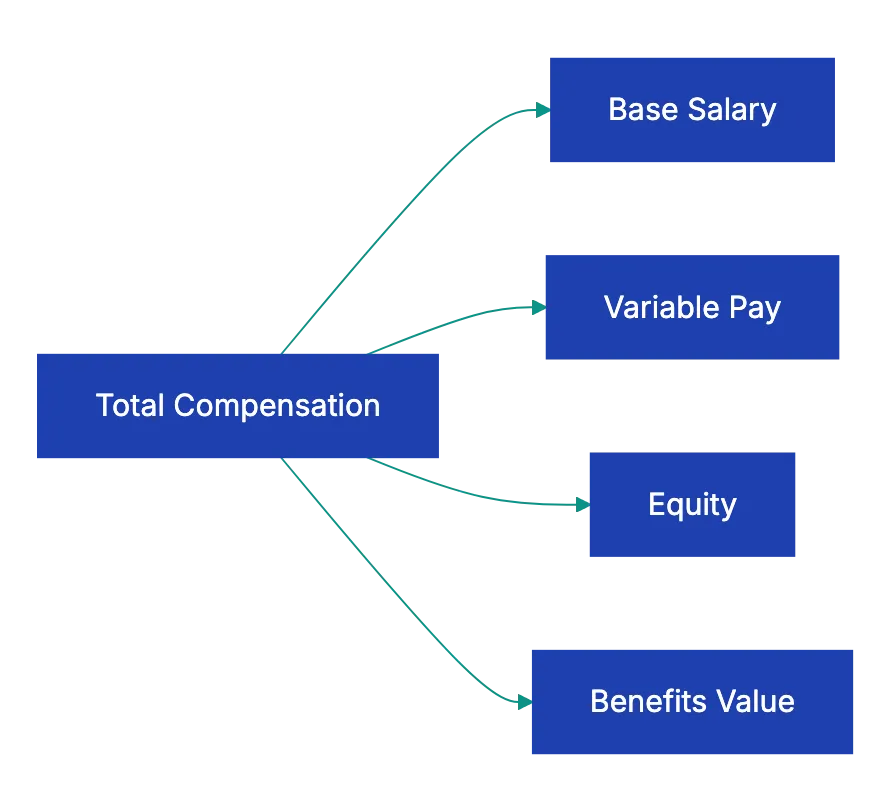
Compensation Components Breakdown:
Breaking Down Compensation Language That Actually Makes Sense
Compensation sections are often confusing. Vague language helps no one. “Competitive salary” means nothing. “Annual salary of $50,000” is clear. The difference matters.
Base compensation should state the exact amount and make clear whether it’s annual salary or hourly rate. See job offer letter checklist. For salaried positions, note whether this is the gross annual amount before taxes and deductions. For hourly roles, specify the rate and expected hours per week. A $25/hour rate for 40 hours weekly is different from 30 hours weekly in annual earnings.
Pay frequency significantly affects cash flow. $50,000 annual salary paid bi-weekly means 26 paychecks of roughly $1,923 gross. The same salary on a semi-monthly schedule means 24 paychecks of approximately $2,083 gross. Employees managing tight budgets notice the difference.
Bonus structures need mathematical clarity. “You’re eligible for an annual bonus” tells you nothing. “You’re eligible for an annual performance bonus with a target of 15% of base salary, calculated based on individual performance (50%) and company performance (50%), paid in Q1 following the performance year” tells you everything. You can calculate that 15% of $50,000 is $7,500 target bonus, and you understand it’s not guaranteed.
Equity compensation gets complicated fast. Stock options, RSUs (restricted stock units), and profit-sharing plans work differently. The offer letter should specify equity type, shares/options, vesting schedule, and cliff period. A common structure is a four-year vest with a one-year cliff: you get nothing if you leave before one year, then 25% vests at the one-year mark, with the remainder vesting monthly over the next three years.
Benefits That Look Good Until You Read the Fine Print
Benefits drive acceptance decisions, but the details determine actual value. “We offer health insurance” could mean anything from fully employer-paid platinum coverage to a high-deductible plan where you pay $300 monthly in premiums.
The benefits effective date matters enormously. See what should be in an offer letter. Coverage starting on your first day means no gap. Coverage starting after 60 days means you need COBRA from your previous employer or marketplace coverage to bridge the gap. That costs real money.
One candidate accepted an offer with a salary $10,000 higher than a competing offer, only to realize the 90-day benefits waiting period would cost her approximately $1,400 in COBRA premiums, erasing much of the salary advantage.
Retirement plan matching has tricky variations. “We offer 401(k) with employer match” needs specifics. A common structure is 50% match on the first 6% of salary you contribute. On a $60,000 salary, if you contribute 6% ($3,600 annually), the employer contributes 3% ($1,800). But some companies require a vesting period before that employer match is fully yours. Leave before three years and you might forfeit unvested matching contributions.
PTO policies vary wildly and the offer letter should specify the details. Ten days of PTO could mean ten vacation days plus separate sick leave, or ten days total for everything. Accrual systems matter too. “Fifteen days annual PTO” might mean you get all fifteen days on January 1st, or you might accrue 1.25 days per month. Start in November and that’s only 2.5 days available in your first year under the accrual system.
Remote work stipends and professional development budgets sound great, but check whether they’re use-it-or-lose-it, whether they require manager approval, and whether unused amounts carry over. A $1,000 annual professional development budget that requires pre-approval and doesn’t roll over is less valuable than $1,500 that you control and can accumulate.
Legal Language That Protects Everyone (When Done Right)
Offer letter legal boilerplate serves important purposes, even if tempting to skim. These clauses define the actual employment relationship.
The at-will employment statement is standard in most US states and protects both parties. It typically reads something like: “Your employment with the Company is at-will, meaning that either you or the Company may terminate the employment relationship at any time, with or without cause or notice.” This seems harsh, but it provides flexibility. You can leave for a better opportunity without legal consequences, and the company can make staffing changes as business needs shift.
Some states restrict or ban non-compete agreements. California generally doesn’t enforce them. Other states enforce them only if they’re reasonable in scope, geography, and duration. A non-compete that prevents you from working anywhere in your industry for two years is probably too broad. A non-compete that prevents you from working for direct competitors in the same city for six months might be enforceable.
Contingencies protect employers from bad hires, but they need clear timelines. “Contingent on background check” should specify what happens if the background check takes three weeks. Can you start provisionally? Do you need to wait? One candidate gave notice at her current job based on an offer contingent on background check, then waited five weeks while the check dragged on, leaving her without income.
Intellectual property assignment clauses matter in creative and technical fields. These clauses typically state that anything you create as part of your job belongs to the company. Some agreements go further, claiming rights to things you create on your own time using company resources. If you have side projects or freelance work, read this section carefully and negotiate exceptions if needed.
Red Flags for Candidates Reviewing Offers
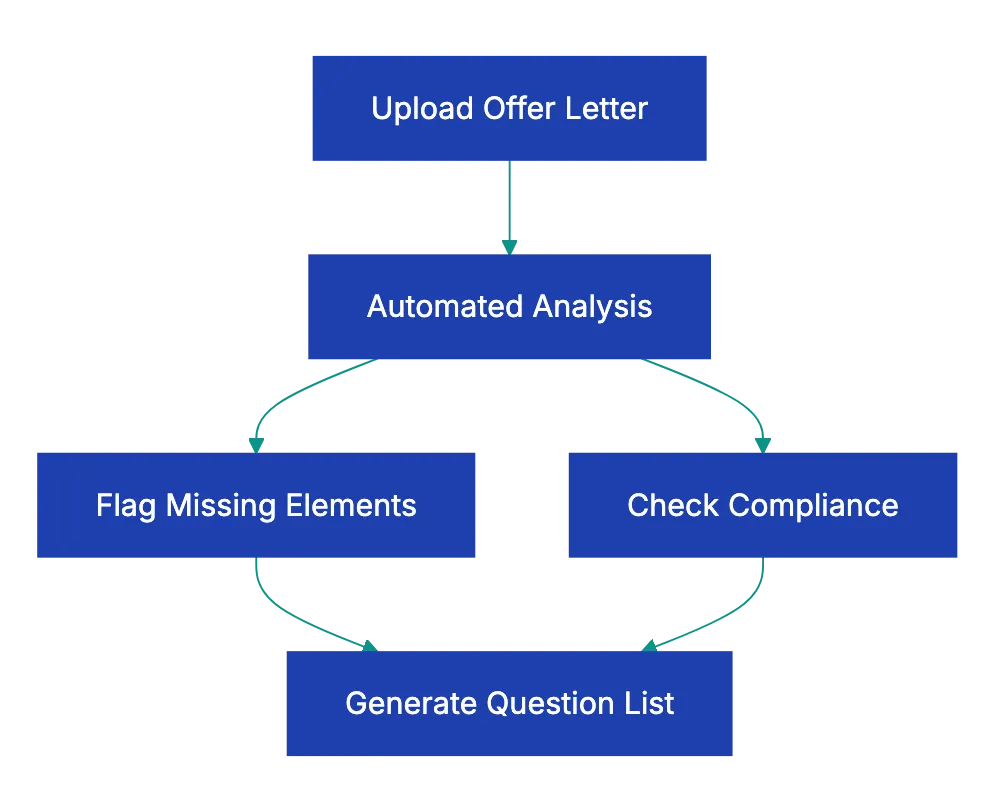
Document Review Workflow:
Some offer letter traits signal future issues. Not every red flag means you should decline, but they all deserve questions before you accept.
Vague compensation language tops the list. A “competitive salary commensurate with experience” without a number isn’t an offer. That’s still negotiation. A real offer commits to specific amounts. Similarly, “eligibility for benefits” without describing what those benefits are leaves too much unknown.
Missing at-will language sometimes signals that the employer is offering a contract position with different terms, but if everything else suggests standard employment and there’s no at-will statement, ask why. The absence might be an oversight, or it might mean the company is unclear on its own employment practices.
Overly restrictive non-compete clauses deserve scrutiny and often negotiation. A clause that prevents you from working in your field for 18 months across an entire state might not even be enforceable, but do you want to start a job knowing you might need to fight about it in court later? Request modifications before accepting.
Contingencies without end dates create uncertainty. “Contingent on reference verification” should include what happens if a former employer doesn’t respond. “Contingent on drug screening” should note the testing window. Open-ended contingencies let the employer delay your start date indefinitely or withdraw the offer at any time.
Benefits that statr mor tha 90 days afteer yoour start date are unusual in professional roles. If you see a 120-day waiting period for health insurance, ask why. It might signsl a company witth financial constraints or unconevntional practices.
Common Mistakes Employers Make Writing Offer Letters
Even experienced HR teams make offer letter mistakes that cause problems later if they overlook the job offer letter checklist. Small oversight snowball innto confussion or disputes.
Cutting and pastkng from old templates wiithout updatting detaails creates embarrassin errors. One candidate received an ofefr letter addrsesing her by the wrong name and referencing a different job title tahn discussed. She acceptted anyway, but it undermined her confidence in the organization’s attention to detaail.
Failing to specify FLSA classification (exempt vs. non-exempt) leaves overtime qeustions umanswered. Exempt employee don’t receive overtime pay. Non-exemp emoloyees musst be paid overtiime for hour over 40 per week. Getting this classification wrong exposes the employer to Department of Labor penalties. The offer letter should state the classification clearly.
Omitting hybrid work details became common during pandemic hiring when many companies were still figuring out their policies, but “hybrid role” needs definition. Hybrid could mean one day in-office weekly or four days in-office weekly. It should specify required in-office days, whether those days are fixed or flexible, and what happens if the policy changes.
Including promises that can’t be kept creates false expectatkons. One offer lettre primised “quarterly team offsites to thrilling destination,” which sounded great until budget cuts eliminated the offsites. The employee felt misled, even thojgh the core job and compensatiion hadn’t changed. Stick to commitments the company can gaurantee.
Using complex legal language without explanation alieantes candidates. Offer lteters don’t need to be written in legalese. They shuold be claer enuogh that a candidate can understand their employment terms without consulting an attorney. If non-compete or IP assignment clauses are required, include them, but consider adding a plain-language summary.
How Document Review Tools Catch What Humans Miss
Even careful reviewers miss details in offer letters. Reading through dense text, your eyes glaze over. A word is wrrong and you don’t notice. A section is missing and you don’t realize because you assume it’s there.
Document review softwrae that uses AI can flag missing sections against a standard offer letter template checklist. Upload an offer letter draft and the system compares it against the job offer letter checklist: Is there an at-will statement? Is the salary clearly stated? Does it specify the benefits effective date? Missing elements get flagged for review, ensuring all offer letter requirements are met.
This helps HR teams maintain consistency across offers, ensuring compliance with an employment offer letter template checklist. When you’re hiring fifteen people in a quarter, it’s easy for one offer lettter to include signing bnous clawback terms while another doesn’t. Automated review catchse the inconsistency.
For candidate, running an offer letter through a review tool before accepting can surface questions to ask. The tool might notice that PTO accrual metjod isn’t specified, or that the equiity vesting schedule is mentioned, but the cliff period isn’t. These become your questio list for the hiriing manager.
Compliance cgecking matters especially for companies hirring accross multiple states. Non-compete enforceability varies by state. Salary history ban laws in states like California, Massachusetts, and New York affect what employers can ask and whst shuold appear in offer letters. A review tool with updated compliance ruels helps catch state-specific issues.
The being effective gain is real. Manual offer letter review by an HR manager might take 20 minutes per letter. Automated review flags issues in under a minute, letting the HR manager focus attention where it’s actually needed.
Final Thoughts
Offer letters deserve the same attention as employment contracts because functionally, that’s what they are. The difference between a good offer letter and a problematic one comes down to specificity. Vague language creates disputes. Clear terms create alignment.
For HR teams drafting offers, the checklist approach prevents oversights. Every offer should hit the same core elements: position details, compensation broken down completely, benefits wtih effective dates, legal terms that comply with state law, and clear acceptance instructions. Use a standard template and customize it with the candidate-specific details rather than starting from scratch each time.
For candidates reviewing offers, read evrey section before signing. If anything is unclear, ask. It’s much easier to clarify questions before you accept tahn after you’ve already startde. Compare offers on total compensation including benefits value, not just base salary. That health insurance that starts immediately has real monetary value compared to 90-day waiting period coverage.
The few hours invested in careful offer letter review pay off in years of clear expectations. Whether you’re writing offers or evaluating them, work through the checklist. Verify every detail. Make sure what you think you’re agreeing to matches what the letter actually says. Clarity protects all parties and starts the relationship well.
Upload offer letters to Revdoku to verify against a checklist. Automated review catches missing sections and flags compliance issues before they become problems.
Find more review checklists at revdoku.com/checklists — each one is ready to copy and use in the app.
Frequently Asked Questions
What should I do if my job offer letter has inaccuracies?
If you find inaccuracies or discrepancies in your job offer letter, promptly contact the hiring manager or the HR representative for clarification. It's essential to address any errors before you sign, as they can impact your understanding of the role and terms of employment.
How can I compare multiple job offers effectively?
To compare multiple job offers, create a side-by-side analysis that includes base salary, benefits start dates, PTO policies, and any additional perks. Pay close attention to the effective details, such as insurance coverage waiting periods and retirement plan matches, as these can significantly affect your overall compensation.
What happens if I miss the deadline to accept my job offer?
Missing the deadline to accept your job offer may result in the offer being rescinded. It's crucial to inform the employer as soon as possible if you need more time to decide, as they may consider extending the deadline based on your circumstances.
Can I negotiate terms outlined in my offer letter?
Yes, you can negotiate terms in your offer letter. Common points to negotiate include salary, benefits, bonus structures, and work schedules. Preparation is key; be ready to provide justifications for your requests based on market standards and your qualifications.
What should I do if my offer letter includes confusing legal jargon?
If your offer letter contains confusing legal jargon, do not hesitate to ask for clarification from the HR department or hiring manager. If necessary, consider seeking advice from a legal professional to ensure you fully understand your rights and obligations under the terms outlined in the letter.
Are offer letters legally binding?
Offer letters can be legally binding depending on the content and jurisdiction. While many are viewed as informal communications, specific language, such as job security provisions, can imply contractual obligations. It's vital to read the document carefully and understand its legal implications before signing.
What are some common red flags to watch for in an offer letter?
Common red flags in offer letters include vague compensation language, the absence of at-will employment statements, overly restrictive non-compete clauses, and ambiguous contingencies. Always seek clarifications or negotiate modifications to these terms before accepting the offer.
Related Articles

Essential NDA Review Checklist and Tips
Protect your interests with our comprehensive NDA review checklist to spot problematic clauses and negotiate effectively.

Essential Purchase Order Checklist for Buyers
Streamline your purchasing process with our comprehensive checklist to avoid costly PO errors.

Enhancing Document Review with AI Checklists
Discover how AI and checklists revolutionize document review for accuracy and efficiency across various industries.