Essential Academic Paper Checklist for Formatting and Citations
Table of Contents
- Introduction
- Understanding Academic Paper Formatting Standards
- Citation Rules That Trip People Up
- Content Structure Elements That Strengthen Papers
- Format Variations: MLA and Chicago Basics
- Common Mistakes That Undermine Otherwise Strong Papers
- Using Technology to Streamline Paper Review
- Preparing for Submission: The Final Review
- Key Takeaways
- Introduction
- Academic Paper Review Checklist
- APA Format Basics
- Abstract and Body Text
- In-Text Citations
- Reference List
- Content Structure
- Tables and Figures
- Submission Requirements
- Understanding Academic Paper Formatting Standards
- Citation Rules That Trip People Up
- Content Structure Elements That Strengthen Papers
- Format Variations: MLA and Chicago Basics
- Common Mistakes That Undermine Otherwise Strong Papers
- Using Technology to Streamline Paper Review
- Preparing for Submission: The Final Review
- Key Takeaways
Introduction
Submitting a paper without review risks errors. A missing citation here, inconsistent formatting there, and suddenly your carefully researched work looks careless. Whether you’re a student preparing a term paper or a researcher submitting to a journal, the details matter as much as the content. This academic paper checklist walks you through every formatting requirement, citation rule, and submission step you need before hitting send.
We’ll focus primarily on an APA format checklist since it’s the most widely required format, but we’ll cover MLA and Chicago variations too. Use this as your final review before any academic submission.
Copy this checklist and paste it into Revdoku’s Generate Checklist to review your documents automatically:
Academic Paper Checklist for Formatting and Citations

You are an academic reviewer and editor with extensive publication experience. Review documents for completeness, proper formatting, and citation accuracy. Check each requirement independently.

- 1-inch margins on all sides of every page
- Entire document is double-spaced including references
- Font is 12pt Times New Roman or 11pt Calibri/Arial
- Running head appears on every page (shortened title in caps, max 50 characters)
- Page numbers appear in top right corner of every page
- Title page includes paper title in bold, centered
- Title page lists author name(s) and institutional affiliation
- Title page includes course number, instructor name, and due date
- Abstract appears on its own page after title page
- Abstract is 150-250 words (verify word count)
- "Abstract" heading is centered and bold with no indentation
- First line of each body paragraph is indented 0.5 inches
- Headings follow APA's 5-level hierarchy system
- All headings are formatted correctly (bold, italic, indentation per level)
- No extra spacing between paragraphs beyond double-spacing
- Every claim from another  source has   an in-text citation
- Direct quotes include page numbers (Author, Year, p. X)
- Paraphrased content includes citations (Author, Year)
- Multiple authors cited correctly (& for two authors, et al. for three+)
- Citations appear before the period in sentences
- Block quotes (40+ words) are formatted correctly without quotation marks
- No citation appears in text without a matching reference entry
- "References" appears centered and bold on new page
- All entries use hanging indent of 0.5 inches
- Entries are alphabetized by first author's last name
- Every in-text citation has a corresponding reference entry
- No reference entries exist without in-text citations
- Author names formatted as Last, F. I.
- DOIs included for all sources that have them
- URLs included for online sources without DOIs
- Publication dates are accurate and formatted correctly
- Journal article titles use sentence case, journal names use title case
- Thesis or research question is clearly stated in introduction
- Literature review covers relevant prior research
- Methodology section provides enough detail for replication
- Results are presented clearly with appropriate tables/figures
- Discussion connects findings back to thesis and existing literature
- Limitations of the study are acknowledged
- Conclusion summarizes without introducing new information
- All tables are numbered sequentially (Table 1, Table 2)
- All figures are numbered sequentially (Figure 1, Figure 2)
- Each table/figure has a descriptive title
- Every table/figure is referenced in the body text
- Tables and figures  appear after the paragraph that first mentions them
- Notes below tables explain abbreviations or provide additional context
- File format matches requirements (.docx, PDF, or other specified)
- File is named according to submission guidelines
- Word count falls within required limits (excluding references)
- All co-author names and affiliations are correct
- Supplementary materials are prepared if required
- Cover letter is written if journal requires one
- Submission portal account is set up and credentials tested
- Any required declarations (conflicts of interest, funding) are included
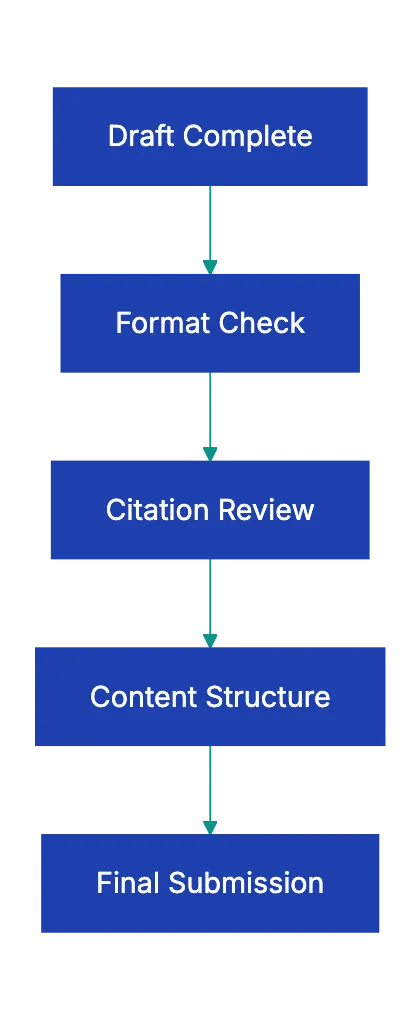
Academic Paper Review Process:
Citation and Reference Relationship:

Understanding Academic Paper Formatting Standards
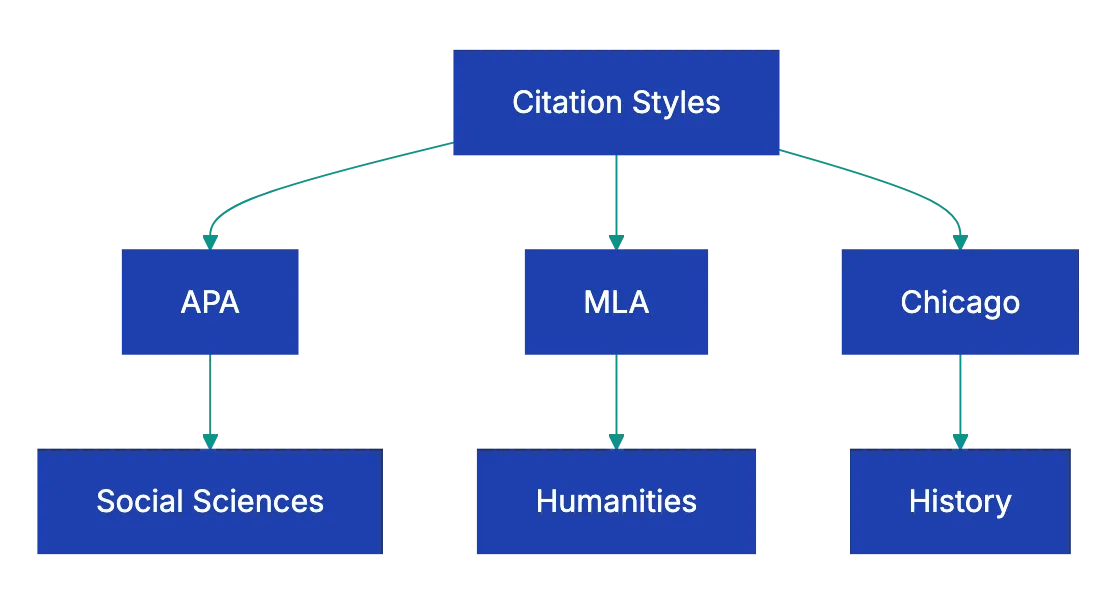
Academic formatting exists for good reason. When everyone follows the same rules, papers become easier to read and compare. Reviewers can focus on your ideas instead of decoding your presentation. The three major citation styles serve different disciplines. APA dominates social sciences, psychology, education, and business. MLA rules humanities and literature. Chicago appears in history and some publication contexts.
APA 7th edition, released in 2019, made several changes that impact academic paper formatting from the 6th edition. The running head no longer needs the words “Running head:” on the first page. Student papers now require different title page elements than professional papers. First person (I, we) is now acceptable when describing your own research. These changes matter because professors and reviewers expect current standards.
The format signals professionalism before anyone reads a word of your content. A paper with consistent academic paper formatting, proper citations, and a clean structure tells reviewers you take your work seriously. Conversely, formatting errors create doubt about the quality of your research. If you missed basic citation rules, what else did you miss?
Many students treat formatting as an afterthought, planning to “fix it later.” This approach costs time. Reformatting an entire paper takes longer than formatting correctly from the start. Set up your template before you write the first draft. Configure your word processor with the right margins, font, spacing, and heading styles. Then you’re just writing, not fighting with formatting.
Citation Rules That Trip People Up
Citations often frustrate writers most. The rules seem arbitrary until you understand their purpose: giving readers a clear path back to your sources. Every citation in your text should lead directly to a reference entry. Every reference entry should connect to at least one in-text citation. No orphans in either direction.
Direct quotes need page numbers in APA. This rule gets forgotten constantly. The citation isn’t complete without it: (Johnson, 2020, p. 47). If you’re quoting from an ebook without page numbers, use paragraph numbers or section headings: (Johnson, 2020, para. 3). The goal is helping readers locate the exact passage you quoted.
Major Citation Style Comparison:
Paraphrasing doesn’t eliminate the need for citations. You still used someone else’s idea, even if you used your own words. The citation just drops the page number: (Johnson, 2020). Students sometimes think paraphrasing means they don’t need to cite. Wrong. That’s plagiarism.
Secondary sources create another common error. If Smith quotes Johnson, don’t cite Johnson unless you’ve read it. Either track down the original Johnson source, or cite it as a secondary source: (Johnson, 1995, as cited in Smith, 2020). Only Smith appears in your reference list.
The reference list formatting has its own traps. DOIs must be formatted as URLs now: https://doi.org/10.xxxx. The old “doi:” format is outdated. Journal names get title case, but article titles use sentence case. Author names never include titles like Dr. or PhD. Attention to detail marks careful work.
Content Structure Elements That Strengthen Papers
Beyond formatting and citations, the structure of your content determines how well readers can follow your argument. Academic papers follow predictable patterns because those patterns work. REaders know where to find information. Reviewers can evaluate your methodology and results effectively.
Your introduction needs a clear thesis or research question — an essential part of a research paper checklist. Not buried in paragraph three. Right up front. Tell readers what you’re investigating and why it matters. Literature reviews should progress logically, grouping related studies together rather than listing sources chronologically. Show how previous research built toward your question.
Methodology sections trip up newer researchers. You need enough detail that someone could replicate your study. Sample size, procedures, materials, data collection methods, analysis techniques. If you interviewed people, what questions did you ask? If you ran an experiment, what were the exact conditions? Peer reviewers will catch vague methodology immediately.
Results sections present findings without interpretation. Save the interpretation for discussion. This separation feels artificial when you’re writing, but it serves a purpose. Readers should be able to look at your results and draw their own conclusions before reading yours. Tables and figures carry heavy weight here. A well-designed table communicates results faster than paragraphs of text.
Discussion sections connect your findings back to the literature review. How do your results confirm, contradict, or extend previous research? Acknowledge limitations honestly. Every study has them. Reviewers respect authors who identify limitations before they have to. Claiming perfection signals inexperience.
Format Variations: MLA and Chicago Basics
While APA dominates many fields, you might need MLA or Chicago depending on your discipline or publication venue. The core principles remain the same: consistent formatting, complete citations, clear structure. The details change.
MLA uses a different citation style. In-text citations include author and page number without a comma or year: (Johnson 47). The Works Cited page uses hanging indents like APA’s reference list, but formatting differs. Author names appear as Last, First. Titles use specific capitalization rules. Containers (the larger work that holds your source) get special formatting.
MLA papers don’t typically require an academic paper checklist for a title page unless requested. Your name, instructor’s name, course, and date appear in the top left of the first page. The paper title is centered, but not bold. Everything is double-spaced from the first line onward. Page numbers appear in the top right with your last name: Johnson 1.
Chicago style offers two citation systems: notes-bibliography and author-date. Notes-bibliography uses footnotes or endnotes with superscript numbers in the text. Author-date works more like APA with parenthetical citations. History papers typically use notes-bibliography. Social sciences using Chicago tend toward author-date.
Chicago formatting allows more flexibility in fonts and spacing, but double-spacing remains standard for submitted papers. The bibliography differs from APA’s reference list in formatting details. Chicago capitalizes more words in titles and uses different punctuation in citations.
Knowing which style your target publication or course requires is the first step in your paper submission checklist. Switching citation styles after writing wastes hours. Check the requirements before you start writing.
Common Mistakes That Undermine Otherwise Strong Papers
Even experienced researchers make preventable errors. Some mistakes appear in nearly every stack of student papers. Knowing them helps you avoid them.
Inconsistent citation style tops the list. Writers start with APA, then slip into MLA halfway through, illustrating the need for a research paper formatting guide. Citation management software prevents this, but only if you use it correctly. Set the style once, then let the software handle formatting.
Forgetting the running head happens constantly. You format the title page perfectly, then the running head disappears on page two. In Word, you need to link section headers and apply the running head to all sections. In Google Docs, the process differs, but the goal is the same: every page needs that shortened title in the header.
Abstract word limits get ignored. The requirement says 150-250 words. You write 320 because you couldn’t cut anything. Reviewers notice. They count. Stay within limits or explain why you need an exception. An overlength abstract signals you can’t follow directions or make editing choices.
Quotes need page numbers. Even if you cite the author and year, a quote needs a page number. This matters more than it seems. Readers want to check your quotes in context. Without page numbers, they can’t easily verify you quoted accurately and fairly.
Plagiarism through careless paraphrasing happens when writers stay too close to the original text. You can’t just swap a few words and call it paraphrasing. You need to genuinely restate the idea in your own sentence structure. If your sentence follows the original sentence’s structure word by word with synonyms substituted, that’s still plagiarism.
Orphaned citations break the connection between text and references. You cite Johnson (2020) in paragraph four, but Johnson doesn’t appear in the reference list. Or Johnson appears in the reference list, but you never cite Johnson in the text. Both error suggest careless editing. They’re easy to fix if you check systematically.
Incorrect heading hierarchy confuses readers. APA’s five levels of headings have specifi formatting. Level 1 is cenetred and bold. Level 2 is flush left and bold. Level 3 is flush left, bol, and italic. Level 4 is indented, bold, and ends with a period. Level 5 is indented, bold, italic, and ends wit a periiod. Jumping frrom Level 1 to Level 3, or using Level 2 formatting for what should be Level 3, disrupts the logical flow.
Using Technology to Streamline Paper Review
Manual checking catches errors, but automated tools catch more. Citation management software, plagiarism checkers, and formatting validators save tiem and improve accuracy. The key is knowing which tools do what.
Zotero, Mendeley, and EndNote manage citations. You add soources once, then insert citations as you write. The software formats everything automatically in whatever style you choose, though a citation checklist remains invaluable. When you need to switch from APA to MLA, you change one setting instead of reformatting hundreds of citations. These tools aren’t perfec. They maek mistakes, especailly wiht unusula sourcce types.
Always verify the formatting of yoru frist few citations to catch sysyematic errrors.
Grammarly and similar writing assistants check gfammar and style, but their citation advice is limited. They catch missing commas and suggesst clearer phrasing. They don’t verify that your citations follow APA rules or that every reference has a matching in-text citatioon. Use them for writing quality, but rely on a citation checklist for citation accuracy.
Plagiarism checkers lik Turnitin show you where your text matches existin sources. Every submitted paper sholud run through a plagiarism checker before submission. Even accidental plagiarism damage yoour credibility. These tools show you problem areas so you can fix them before reviewers see them.
Document review platforms like Revdoku let you build custom checklists for your specific requirements. If your university has specific formatting ruels beyond standard APA, or your target journal has unusual submission requirements, you can create a checklist that captures every requiremsnt. Then you review your document systematically, checking each item rather tha hoping you remember everything.
Word processors ahve built-in tools that help with formatting. Styles in Microsoft Word let you apply consistent heading formatting throughout your document. The table of contents generator only works correctly if you use heading styles properly. Learning your word processor’s advanced features pays off when you’re formatting a long pape.
PDF comparison tools show differences between drafts. If you’re woorking with co-authors or responding to reviewer feedback, comparing your crurent version to the previou version shows exactly what changed. This prevents accidentally undoing corrections or missing requested edits.
Preparing for Submission: The Final Review
You’ve wirtten the paper, formatted it correctly, and checked your citations. You’re not done. The fihal review before submission catches errors that slkp through earlier checks.
Read the entire paper out loud. This sounds tedious, but it catches errors your eyes skip when reading silently. Awkward phrasing, missing words, and unclear sentences become obvious whhen you hear them. If you can’t read a sentence smoothly, rewrite it.
Print the paper if poossible. Errors hide on screens. Paper reveals them. You’ll spot formatting inconsistencies, margin problems, and spacing issues that looked fine on screen. If printing isn’t praactical, change the view in yohr word processor. Switch to a diffreent font temporarily, or chaneg the zoom level. Seeing the text differently helps you see errors.
Check every citation against the reference list manually. Yes, htis tskes time. Yes, it’s worht it. Mark each in-text citation as you verify its reference entry exists. Then go trhough the reference list and mar each entry as you veirfy it’s cited in the text. Orphans reveal themselves.
Verify every number, date, and statisti. Did you write 2019 whn you meant 2020? Did you cite the wron page number? Did you transpose digits in a statistical result? These errors are easy to mak and eqsy to mies. They’re also embarrassing when reviewwers catch them.
Confirm the file format and naming. If the submission system requires PDF, don’t submit a .doc file. If the naming convention is LastName_CourseName_Assignment, don’t name it “Final Draft Version 3.” Follow directions exactly.
Test supplementary materials. If you’re submitting data files, coed, or appendices, open them and verify they work. A corrupted file or broken link wastes reviewers’ time and reflects poorly on you.
Double-check submission deadlines and requirements. Time zones matter; a detailed paper submission checklist can prevent timing errors. If the deadline is 11:59 PM EST and you’re in PST, you have three fewer hours than you think. Upload early enough that technical problems won’t mkae you lzte.
Key Takeaways
Submitting an academic paper without systematiic review invites avoidable errors. This checklisst coverrs the formatting, citation, content, and submission requirements that appply to most academic papers, with emphasis on APA 7th edition as the most commo standard. Format correctly from the start rather than fixing everything later. Use citation management software to maintain consistency.
Check every citation aganist yuor refereence list manually to catch orrphans. Review your paper in different formats to spo errors your eyes skip on screen. Technology helps, but human review catches what automated tools miss.
Before you submit your next paper, upload it to Revdoku and run through a systematic review. Build a custom checklist that includes your organization’s specific requirements alongside standard formatting and citation rules. The fifteen minutes you spend on a final review prevents the frustration of rejection for fixable errors. Your research deserves presentation that matches its quality.
Find more review checklists at revdoku.com/checklists — each one is ready to copy and use in the app.
Frequently Asked Questions
What should I do if I'm unsure about which citation style to use?
Start by checking the requirements set by your course or the journal you plan to submit to. Different academic fields typically favor specific styles, such as APA for social sciences and MLA for humanities. If you’re still unclear, consult your professor or editor for guidance.
How can I ensure my citations are accurate before submitting my paper?
Manually compare every in-text citation with your reference list to ensure they match. Look for orphans, which are citations without matching references or vice versa. Utilizing citation management software can help, but it's essential to double-check for any systematic errors.
Are there any specific tools that can assist in formatting my paper?
Yes, citation management software like Zotero or EndNote can streamline the citation process. Additionally, grammar checkers such as Grammarly can help improve overall writing quality, though they may not verify specific citation formatting rules. Familiarizing yourself with your word processor's advanced formatting features can also aid in maintaining consistency.
How do I handle the submission of supplementary materials?
Ensure that all supplementary materials are organized and named according to the submission guidelines. Before submission, open each file to verify that they function correctly and are in the required format. This prevents issues that may arise from corrupted files or broken links during the review process.
What are common mistakes to avoid when formatting a paper?
Common pitfalls include inconsistent citation styles, missing page numbers for direct quotes, and incorrect heading levels. Additionally, not adhering to word limits for abstracts and omitting necessary content like running heads can undermine your work. A systematic review, using a checklist, can help catch these errors.
Why is it important to read my paper out loud before submission?
Reading aloud helps identify awkward phrasing, clarity issues, and even missing words that might not be as noticeable when reading silently. It allows you to engage with the text aurally, which can reveal errors and improve overall flow before submission.
How can I prevent technical issues related to submission deadlines?
Be aware of your time zone in relation to the submission deadline and aim to upload your work well ahead of the cutoff time. A detailed paper submission checklist can help you track all requirements and ensure that you don’t overlook critical details, including file formats and naming conventions.