OpenClaw vs Hermes vs Instinct vs Grok vs Muse
Table of Contents
- OpenClaw vs Hermes vs Instinct vs Grok Bot vs Meta Muse: summary
- Where each agent runs: your server or the vendor cloud
- OpenClaw: self-hosted only
- Hermes Agent: self-hosted or hosted by Nous Research
- Grok Bot: vendor cloud only
- Meta Muse: vendor cloud only
- Instinct: vendor cloud only
- What you pay: plans, AI models and servers
- API keys or a ChatGPT, Claude or Grok subscription
- Ready-made OpenClaw and Hermes servers and VM images
- Minimum and recommended hardware
- Channels and features of the five agents
- Security record: why to use a separate machine or VM
- OpenClaw
- Hermes Agent
- Grok Bot
- Meta Muse
- Instinct
- Which one to choose: OpenClaw alternatives by situation
A personal AI agent is an assistant that you message in a chat app and that does tasks for you. OpenClaw vs Hermes is the usual first choice, because both are open source and you can run them yourself. Three closed OpenClaw alternatives from large companies do a similar job: the Instinct AI agent, Grok Bot and Meta Muse. This article compares where they run, what you pay, the ready-made servers and their security.
The names are not always clear. They mean these products:
- OpenClaw is the open-source assistant from the OpenClaw Foundation.
- Hermes is Hermes Agent, the open-source agent from Nous Research.
- Instinct is the invite-only agent from Spear Street Technology, Inc. It is not Open Instinct, an unrelated clone.
- Grok is Grok Bot, the hosted, always-on agents from SpaceXAI (xAI) and Cursor. It is not Grok Build, the xAI coding agent.
- Muse is Meta Muse, the personal agent from Meta. Muse Spark is its model, not a separate agent.
OpenClaw vs Hermes vs Instinct vs Grok Bot vs Meta Muse: summary
| Agent | Maker | Open source | Where it runs |
|---|---|---|---|
| OpenClaw | OpenClaw Foundation | Yes, MIT | Your computer, VM or VPS |
| Hermes Agent | Nous Research | Yes, MIT | Your computer, VM or VPS, or Nous Portal Cloud |
| Grok Bot | SpaceXAI (xAI) and Cursor | No | Cursor’s cloud, in the US |
| Meta Muse | Meta | No | Meta’s cloud, one VM for each user |
| Instinct | Spear Street Technology | No | Instinct’s cloud |
A VM (virtual machine) is a computer that runs as software on another computer. A VPS (virtual private server) is a VM that you rent in a data center. You cannot self-host Grok Bot, Meta Muse or Instinct, or choose their VM size. Only OpenClaw and Hermes Agent have ready-made servers with a published configuration.
OpenClaw has about 394,000 stars on GitHub, and Hermes Agent has about 261,000. On Meta Muse vs OpenClaw, Meta’s Nat Friedman told TNW: “We built Muse from scratch, but it is definitely heavily inspired as a product by OpenClaw.”
Where each agent runs: your server or the vendor cloud
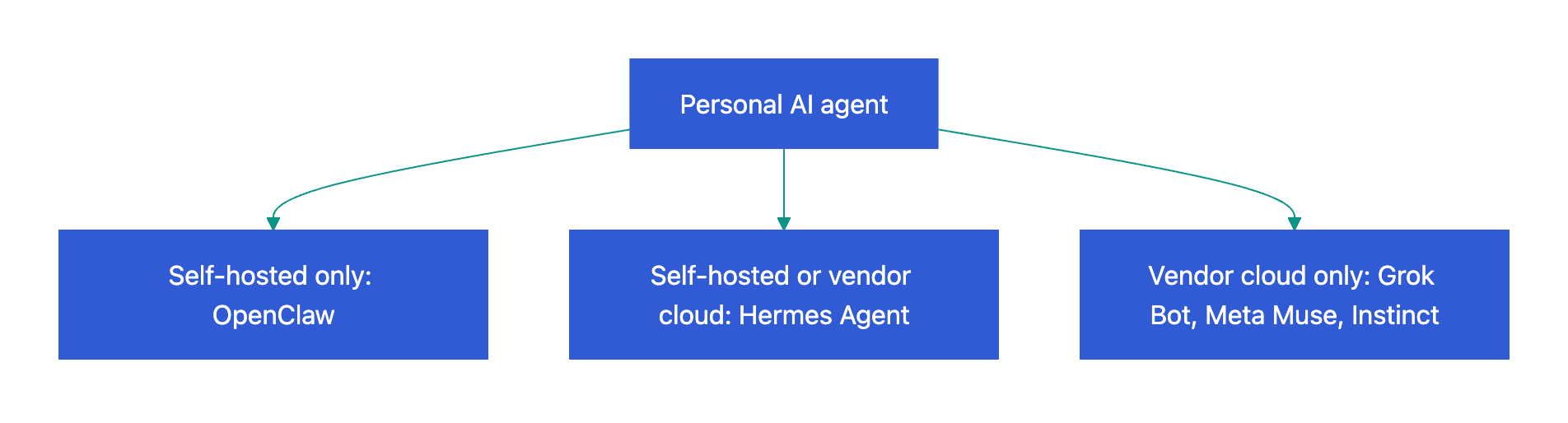
Self-hosted, vendor cloud or both:
OpenClaw: self-hosted only
The OpenClaw site says: “No subscription. No hosted tier.” Install it on Mac, Windows or Linux with Node 24.16 or later, or 26.1 or later. Some hosting companies sell a managed OpenClaw server.
Hermes Agent: self-hosted or hosted by Nous Research
Hermes Agent installs on Linux, macOS, Windows, WSL2, Android (Termux) and Docker. Nous Research also runs it as a cloud agent on Nous Portal, in 14 regions.
Grok Bot: vendor cloud only
Each member (user) gets one Linux computer in Cursor’s cloud, in the US (deployment docs). All of your Bots share its files, browser sessions and CLI sign-ins. Grok Bot can also run commands on your own computer, but only if you allow it.
Meta Muse: vendor cloud only
Each Meta Muse user gets one “Muse Secure VM”. Meta’s security post says that the agent runs in a systemd-nspawn container with Debian, and a guard program, Sentinel, runs outside it. Muse launched in the US.
Instinct: vendor cloud only
The Instinct AI agent uses its own phones and computers. Founder Noah Shinn wrote at the beta launch: “You can text or call it. It’s trained to use a phone and a computer in the same way that humans do.”
What you pay: plans, AI models and servers
Prices are as of November 2026.
| Agent | Software or plan | AI model | Server |
|---|---|---|---|
| OpenClaw | Free | Your API key or a supported subscription | Your computer, or a VPS from about $6 a month |
| Hermes Agent | Free; Nous Portal: Free $0, Plus $20, Super $100, Ultra $200 a month | Your API key, a supported subscription, local models or Nous credit | Your computer, a VPS, or a Nous cloud agent billed from Nous credit |
| Grok Bot | X Subscription: Premium $30, Super $100, Ultra $200 a month | Included; no own key, no model choice | Included |
| Meta Muse | Free tier with a limit; Power $20, Maximum $100 a month | Included; Muse Spark only | Included |
| Instinct | No public price; invite only | Included; no own model | Included |
- Grok Bot: The X Subscription pricing gives 4 times the usage on Premium, 15 times on Super and 50 times on Ultra. Plus ($8 a month) does not include Grok Bot. Cursor also includes it with older paid Cursor plans, linked SuperGrok accounts and Grok Business seats.
- Meta Muse: Power gives 500 million Muse tokens a week, Maximum 3 billion (Meta help). A token is a unit of text that an AI model counts. Muse asks for a payment card even for the free tier.
- Hermes Agent: Nous Portal lists a cloud agent size for each paid plan, but also bills the instance daily from your Nous credit. Before you buy, make sure that you know what the plan fee covers.
API keys or a ChatGPT, Claude or Grok subscription
OpenClaw and Hermes Agent need an AI model. The clearest path is an API key, paid for each token. Both agents can also sign in with a ChatGPT or Codex subscription, and the OpenClaw docs state that OpenAI “explicitly supports” this use. For Claude, use an Anthropic API key. Do not connect either agent to a Claude Pro, Max or Ultra plan: Anthropic’s terms do not let third-party tools route requests through plan credentials, and Anthropic has banned accounts for this use. A SuperGrok or X Premium sign-in works in both, but xAI decides which accounts get tokens. Some SuperGrok accounts got an HTTP 403 error. Hermes Agent also runs local models with Ollama, vLLM or LM Studio.
Ready-made OpenClaw and Hermes servers and VM images
Grok Bot, Meta Muse and Instinct publish no specs for their hosted machines. A vCPU is one virtual processor core.
| Agent | Option | vCPU | RAM | Disk | Price a month |
|---|---|---|---|---|---|
| OpenClaw | AWS Lightsail blueprint, recommended 4 GB plan | 2 | 4 GB | 80 GB SSD | $24, plus Amazon Bedrock model use |
| OpenClaw | DigitalOcean 1-Click app, Ubuntu 24.04, size from the DigitalOcean example | 2 | 4 GB | 80 GB | $24 |
| OpenClaw | DigitalOcean Droplet, manual setup from the OpenClaw guide | 1 | 1 GB, plus 2 GB swap | 25 GB SSD | About $6 |
| OpenClaw | Hostinger Managed OpenClaw | Not shown | Not shown | Not shown | $4.99 for a 24-month term, then $11.99 |
| Hermes Agent | Nous Portal Plus | Not shown | Up to 4 GB | 25 GB | $20 plan, instance billed from credit |
| Hermes Agent | Nous Portal Super | Not shown | Up to 4 GB | 100 GB | $100 plan, instance billed from credit |
| Hermes Agent | Nous Portal Ultra | Not shown | Up to 8 GB | 100 GB | $200 plan, instance billed from credit |
| Hermes Agent | Hostinger KVM 1 with the Hermes Agent template | 1 | 4 GB | 50 GB NVMe | $6.49 for a 24-month term, then $11.99 |
| Hermes Agent | Hostinger KVM 2 | 2 | 8 GB | 100 GB NVMe | $8.79, then $14.99 |
| Hermes Agent | Hostinger KVM 4 | 4 | 16 GB | 200 GB NVMe | $12.99, then $28.99 |
| Hermes Agent | Hostinger KVM 8 | 8 | 32 GB | 400 GB NVMe | $25.99, then $49.99 |
Notes:
- The Lightsail blueprint uses Amazon Bedrock with Claude Sonnet 4.6 by default. It runs a Docker sandbox and rotates its access token every day.
- The OpenClaw DigitalOcean guide warns against Marketplace images that nobody reviewed.
- The Hostinger Hermes template adds a web admin panel.
- The OpenClaw VPS page lists more hosts, for example Hetzner, Fly.io, Oracle Always Free ARM, and one-click setups on Northflank and Railway.
Minimum and recommended hardware
Neither project publishes a minimum for a normal Linux server. The docs give these numbers:
| Agent | Minimum | Recommended | Source |
|---|---|---|---|
| OpenClaw on a Raspberry Pi | 1 GB RAM, 1 core, 500 MB disk, 64-bit OS | 2 GB RAM or more, 16 GB storage or more | Raspberry Pi page |
| OpenClaw, Docker image built from source | 6 GB RAM for the build | Not stated | Hetzner page |
| Hermes Agent | Not published | “Run it on a $5 VPS” | GitHub README |
Channels and features of the five agents
| Feature | OpenClaw | Hermes Agent | Grok Bot | Meta Muse | Instinct |
|---|---|---|---|---|---|
| Channels | 29, for example WhatsApp, Telegram, Discord, Slack, Signal, iMessage | Telegram, Discord, Slack, WhatsApp, Signal, email, CLI | Desktop apps, iOS, Android, group chats, @bot on X | Muse app (iOS, Android), muse.ai, WhatsApp | Text, phone calls, group chats |
| Scheduled and background tasks | Cron rules, one-shot jobs, event triggers, webhooks | Built-in cron, delivery to any channel | Routines at least 5 minutes apart, up to 50 for each Bot | Continues to work after you close the app | No public docs |
| Skills | ClawHub skills and plugins | Writes and improves its own skills | “Teach a task” recordings of up to 10 minutes | Not stated | No public docs |
| MCP | Client and server | Client | App catalog and custom MCP servers | Not stated | No public docs |
| Computer use | Browser, files, shell (full or sandboxed) | Browser and a computer-use driver | Browser and computer use; you take over for SSO and CAPTCHAs | Own browser | A phone and a computer |
MCP (Model Context Protocol) is a standard way to connect an agent to tools. Grok Bot routines can also start on events from Slack, GitHub, Linear, Sentry, PagerDuty or email (docs). Instinct has its own email address at mail.instinct.com.
Security record: why to use a separate machine or VM
All five agents read web pages or messages from other people. A prompt injection is text in them that tells the agent to do a task that you did not ask for.
OpenClaw
The security docs say that OpenClaw is for “one trusted operator”. Run openclaw security audit after setup. The record:
- The project security page lists 1,799 reports since January 2026 and 722 fixes. In total, 39 issues have a CVE (a public ID for a security bug). The 14 issues at the highest severity level are all fixed.
- An independent tracker counts 543 CVEs that name OpenClaw. Its scope is different, so do not compare the two numbers.
- In February 2026, SecurityScorecard found 40,214 OpenClaw instances open on the internet. Of the first 28,663 IP addresses that it checked, 12,812 were open to remote code execution (Techzine). OpenClaw then used the default address 0.0.0.0:18789, which listens on all networks. Version 2026.1.29 fixed CVE-2026-25253 (CVSS severity score 8.8 of 10).
- Koi Security found 824 malicious skills among more than 10,700 on ClawHub, and Unit 42 found 5 that passed the scans (CSA research note).
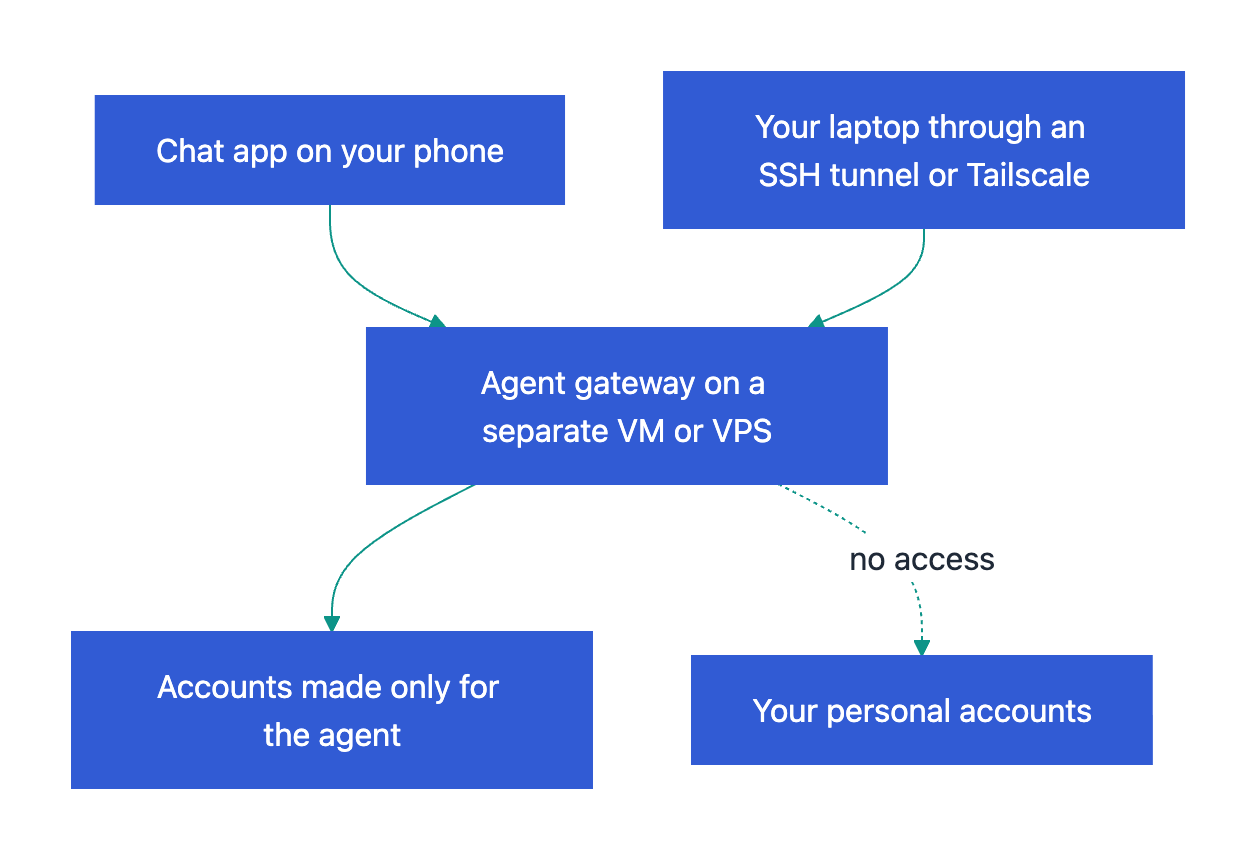
The OpenClaw VPS page says: “Use a dedicated runtime” (a VPS, a VM or a container with its own OS user). Keep the gateway (the OpenClaw server process) on loopback, so that only the machine itself can reach it. Connect through an SSH tunnel or Tailscale. Do not sign the agent in to your personal Apple or Google accounts, browser profiles or password manager.
A safe setup for a self-hosted agent:
Hermes Agent
The Hermes security docs list approval for dangerous commands (denied after 300 seconds), a hard blocklist and users denied by default. They also list pairing codes, a hardened Docker backend and secrets removed from child processes. Injection scanning uses “heuristics, not semantic intent detection.” The vendor advice: “For maximum security, run the gateway on a separate machine or VM.” The GitHub repository publishes no security advisories. But the CVE list has 2026 records for Hermes Agent. Examples are CVE-2026-9368, a sandbox issue in execute_code, and CVE-2026-10220, an injection in the skills tool. Keep Hermes Agent up to date.
Grok Bot
Grok Bot uses an Auto Review model for risky actions, approvals for each action and sign-in tokens that stay on Cursor’s servers (security docs). Network allowlists and audit logs are only on Enterprise plans. The docs say that the injection controls “reduce but do not eliminate the risk.” Because all your Bots share one computer, one bad web page can reach the sign-ins of all of them, as Pinggy’s comparison points out.
Meta Muse
Sentinel is the only part that can allow, deny or ask about outgoing traffic and connector actions. The agent holds only surrogate tokens (stand-ins for the real credentials), and its browser sub-agent cannot run JavaScript. Meta pays bug bounties of up to $300,000. But Meta staff access is limited “by operational policies, not by technical controls.” An encrypted “Muse Confidential VM” is planned for later in 2026.
Instinct
The Instinct terms appoint Instinct “as your agent to enter into agreements” and say that actions “may not be reversible.” Instinct trains on your data by default; you can turn this off in the settings. In a test posted on X, a stranger emailed instructions to Instinct, and “Instinct happily followed the instructions!” After an incident in September 2026, Shinn blamed a hallucination and said it was “not a data breach.”
Which one to choose: OpenClaw alternatives by situation
How to choose:
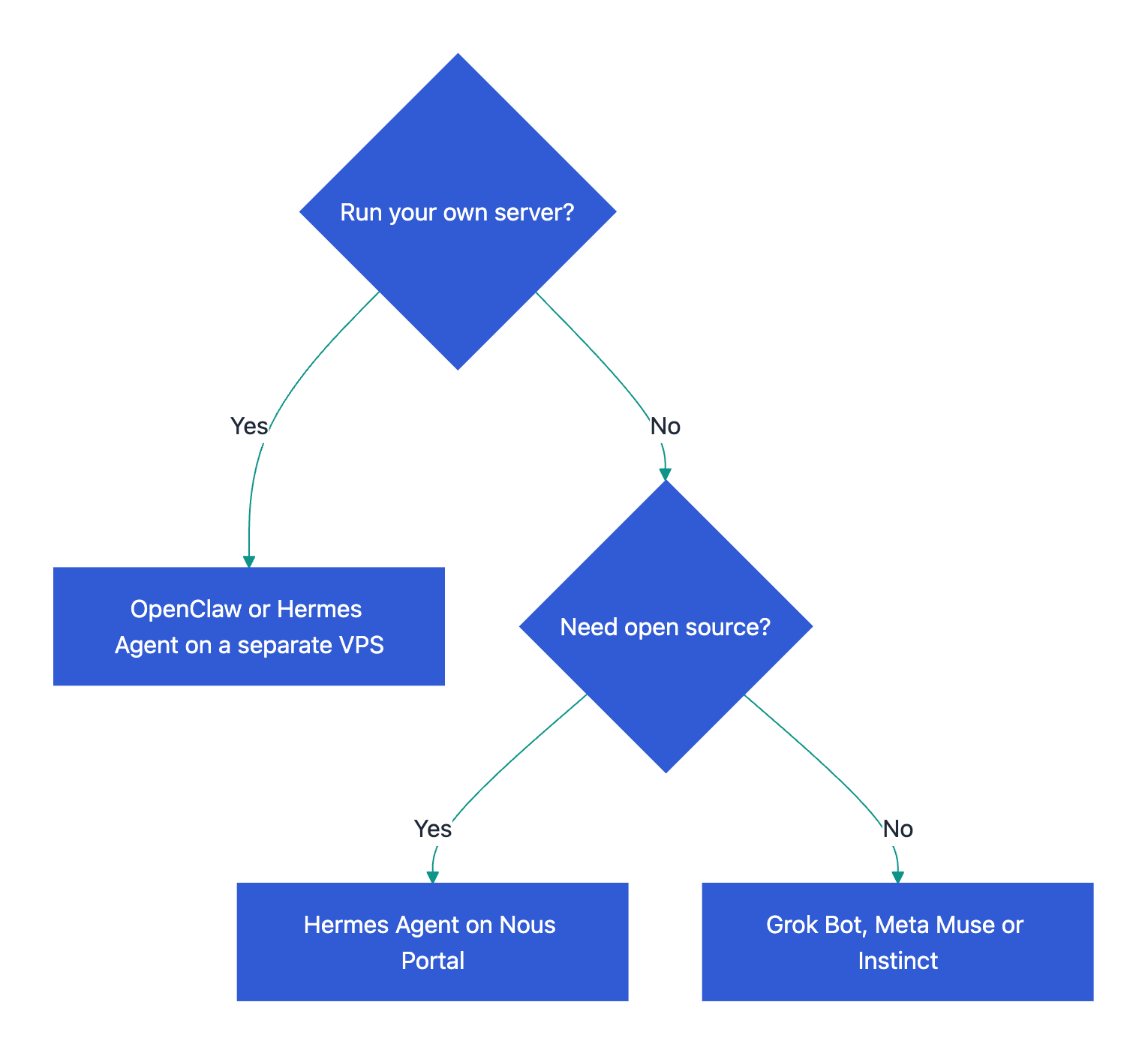
Use OpenClaw when you want the most chat channels and skills, and you can run and update a server. Start with the Lightsail blueprint or a VPS with 2 vCPU and 4 GB of RAM, the size that Lightsail recommends. Read each skill before you install it.
Use Hermes Agent when you want open source with the option of vendor hosting on Nous Portal. It also fits when you want local models or an agent that writes its own skills. Start with Hostinger KVM 1 or a Nous Portal plan.
Use Grok Bot when you already pay for X Premium or a Cursor plan, and your work starts in Slack, GitHub, Linear, Sentry or PagerDuty. All your Bots share one computer, so every Bot can use every sign-in on it.
Use Meta Muse when you are in the US and want an agent in WhatsApp without a server. Of the three cloud agents, Muse publishes the most detail on its isolation.
Use Instinct when you have an invite and want an agent that you text or call like a person. Read the terms first: its actions can be final, and it can make agreements for you.
Some needs rule out the cloud agents: your own choice of AI model, data on your own hardware or a known VM configuration. For these needs, use OpenClaw or Hermes Agent on your own VM.
A self-serve support and documentation portal
for your product or service
With AI search and answers, support tickets and analytics.
- A support portal with public Help Center articles
- AI search and AI answers
- Docs from your GitHub repository, for APIs, dev tools and other complex products
- A support widget for your website
- Made for AI agents to read and search: Markdown pages and a built-in MCP server
- Analytics: who viewed and searched your docs and articles, and when
- Private support tickets to track customer requests
Try it: press Ask at the lower right of this page.
Frequently Asked Questions
Can I stop a Nous Portal cloud agent to pay less?
Yes. Nous Portal meters the running time of a cloud agent to the second and also bills its storage. A stopped instance pays only for storage. The Nous Portal cloud page also says that model use and tool use are billed separately, on top of the instance price.
Can several people share one OpenClaw installation?
Not safely. The OpenClaw security docs say that OpenClaw is made for “one trusted operator” and is “not a hostile multi-tenant security boundary”. If several people need an agent, give each person a separate installation on a separate VM.
Which of the five agents can I try for free?
OpenClaw and Hermes Agent are free software. With a local model, Hermes Agent costs nothing more than the computer that runs it. Nous Portal has a Free plan with free models, but it does not include a cloud agent. Meta Muse has a free tier, but it asks for a payment card. Grok Bot needs a paid plan, and Instinct needs an invite.