
How to Review Medical Bills for Errors
Table of Contents
- Introduction
- Why Medical Bill Review Matters
- Understanding Your Medical Bill Components to Check Medical Bills
- How to Request and Review an Itemized Bill
- Comparing Your Bill to Your Explanation of Benefits
- Common Medical Billing Errors to Watch For
- What to Do When You Find Errors
- Using Technology and AI for Medical Bill Review
- Key Takeaways
- Introduction
- Medical Bill Review Checklist
- Personal Information Verification
- Itemized Charges Review
- Insurance Processing Check
- Pricing and Fee Verification
- Common Error Detection
- Why Medical Bill Review Matters
- Understanding Your Medical Bill Components to Check Medical Bills
- How to Request and Review an Itemized Bill
- Comparing Your Bill to Your Explanation of Benefits
- Common Medical Billing Errors to Watch For
- What to Do When You Find Errors
- Using Technology and AI for Medical Bill Review
- Key Takeaways
Introduction
Medical bills are complex, and errors are common. typos, duplicate charges, incorrect insurance processing, and miscoding all happen frequently. Reviewing each line with a consistent checklist helps a billing team catch issues before they reach the patient. This guide walks through how a billing team can structure that review using a complete medical bill review checklist.
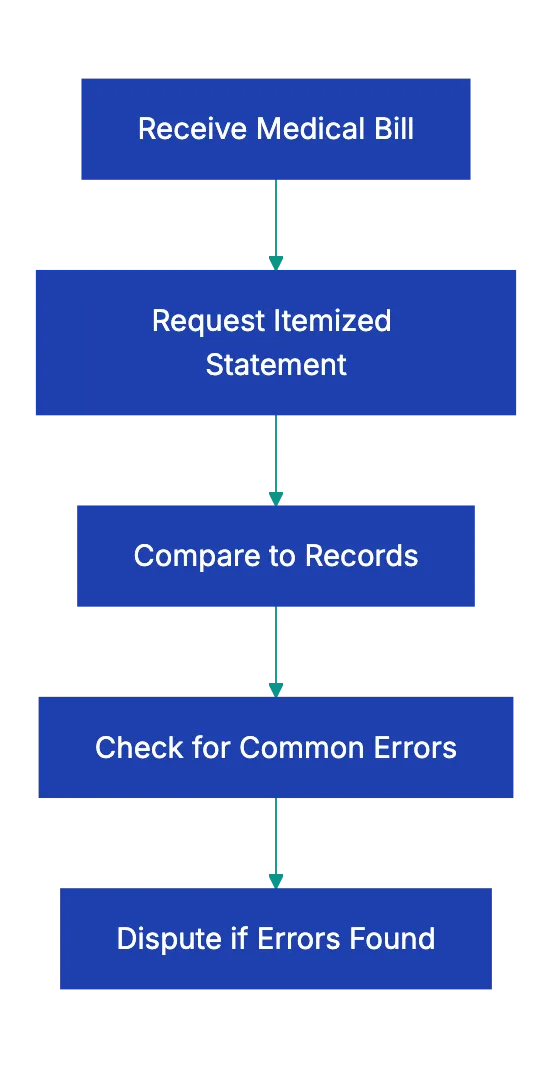
This process helps catch billing mistakes before you pay.
Medical Bill Error Detection Process:
Copy this checklist and paste it into Revdoku’s Generate Checklist to review your documents automatically:
How to Review Medical Bills for Errors

Apply the rules below to this medical bill. For each rule, mark whether the document satisfies it and quote the relevant line item. Check each requirement independently and surface every potential issue. Do not determine whether billing was correct. surface findings for the billing team's review.

- Verify your name is spelled correctly on all documents
- Confirm your date of birth matches your records
- Check that your address is current and accurate
- Verify insurance company name is correct
- Confirm insurance policy number matches your card
- Check insurance group number is accurate
- Verify the date of service matches when you received care
- Confirm the provider name and facility are correct
- Request an itemized bill if you only received a summary statement
- Match each charge to a service you actually received
- Look for duplicate charges for the same service on the same date
- Check for charges for canceled or no-show appointments
- Verify procedure codes (CPT codes) match the services described
- Look for unbundled charges that should be billed as one procedure
- Confirm room charges match the actual room type you occupied
- Verify medication names, dosages, and quantities are accurate
- Check for charges for supplies or equipment you didn't use
- Look for charges for items you brought from home
- Confirm the bill was submitted to your insurance company
- Compare the provider bill to your Explanation of Benefits (EOB)
- Verify in-network rates were applied for in-network providers
- Check that your deductible amount is correctly calculated
- Confirm co-pay amounts match your plan documents
- Verify out-of-pocket maximum limits were respected
- Review any insurance denials for validity
- Check that insurance payment amounts are correctly credited
- Compare charges to fair pricing benchmarks (Healthcare Bluebook, Medicare rates)
- Verify facility fees are separated from physician fees
- Check for unexpected facility fees for outpatient procedures
- Look for charges for routine items included in room fees
- Verify anesthesia time matches the actual procedure duration
- Check lab and diagnostic test charges against standard rates
- Look for upcoding: billing for more expensive procedures than performed
- Check medical bills for balance billing from in-network providers
- Identify charges for basic supplies that should be included in room rates
- Look for incorrect quantity counts on medications or supplies
- Check for services billed at a higher level of care than provided
- Verify no hospital bill errors appear for time before admission or after discharge
Why Medical Bill Review Matters
The financial stakes of medical billing errors are higher than most people realize. A 2020 study published in JAMA found that nearly one in five insured adults received a surprise medical bill in the previous two years, with the average unexpected bill exceeding $1,200. Beyond surprise bills, routine medical billing mistakes quietly drain household budgets.
Hospital billing systems process millions of charges monthly, and the complexity creates countless opportunities for error. A typical hospital stay might generate hundreds of individual line items, each representing a service, medication, supply, or test. When billing staff manually enter procedure codes, transpose numbers, or apply incorrect insurance information, errors cascade through the system. Insurance adds complexity with coverage rules and contracts.
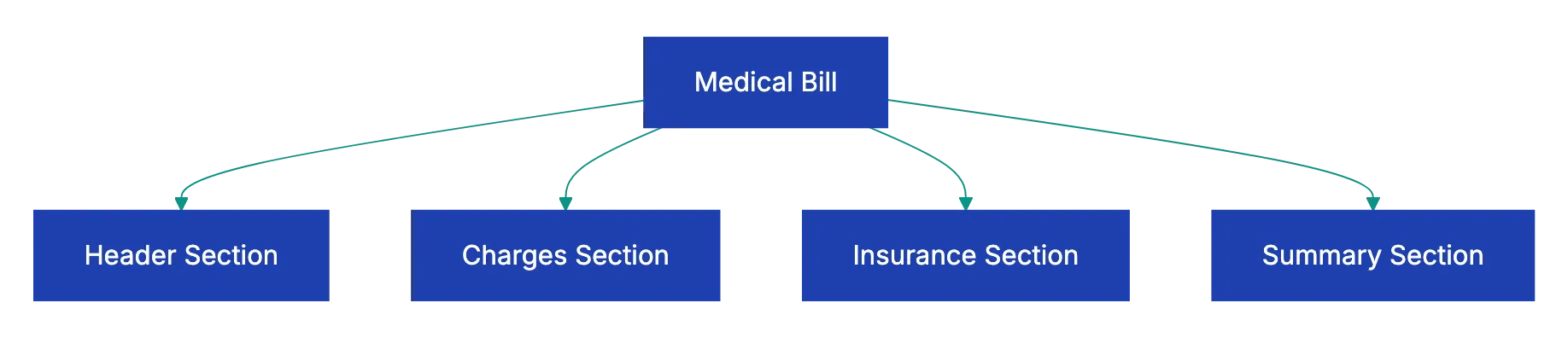
Medical Bill Components Structure:
The problem extends beyond hospitals. Doctor’s offices, outpatient surgery centers, imaging facilities, and laboratories all generate bills with similar error rates. Even a routine doctor’s visit can produce billing mistakes when staff code the visit at the wrong complexity level or fail to apply insurance payments correctly. For patients, these errors translate to real money.
Overpaying by $50 here and $200 there adds up quickly, especially for families managing chronic conditions or recovering from major health events.
Reviewing your medical bills isn’t about distrusting healthcare providers. It’s about recognizing that medical billing is a human process operating within a broken system. Providers often don’t set the prices, billing staff work under time pressure, and insurance rules change constantly. Your review acts as quality control, catching mistakes before they drain your bank account.
Understanding Your Medical Bill Components to Check Medical Bills
Before you can spot errors, you need to understand what you’re looking at. Medical bills typically include several key sections, and knowing what each contains helps in how to check medical bills for errors you review systematically.
- Header section: identifies you, your insurance, and basic visit information. name, date of birth, address, insurance company, policy numbers, date of service, and provider name
- Charges section (itemized statement): lists every service, procedure, medication, and supply billed. Each line item includes a description, a procedure code (usually a CPT code for procedures or an HCPCS code for supplies), the quantity, and the charge amount. This section is where most errors hide.
- Insurance section: shows how your insurance processed the claim. the negotiated allowed amount, the amount they paid, any adjustments, and what you owe (deductibles, co-pays, co-insurance, denied charges)
- Summary section: totals original charges, insurance payments, and your remaining balance. This is the last place to look when reviewing for errors. start with the detailed line items instead.
Many providers initially send only a summary statement, which complicates the hospital bill review process showing the total amount due without itemization. This makes error detection nearly impossible. You have the legal right to request an itemized bill, and you should always do so before paying any substantial medical bill. The itemized version reveals the individual charges you need to review.
How to Request and Review an Itemized Bill
Getting an itemized bill is your first step in any medical bill review. When you receive a summary statement, contact the provider’s billing department immediately and request an itemized statement. You can usually do this by phone, through the provider’s patient portal, or in writing. Be specific: ask for a fully itemized bill that shows every individual charge, not just categories.
Providers must provide itemized bills though it may take days. If opposed, insist on reviewing charges before payment to understand them. Most billing departments will comply readily once you make a clear request.
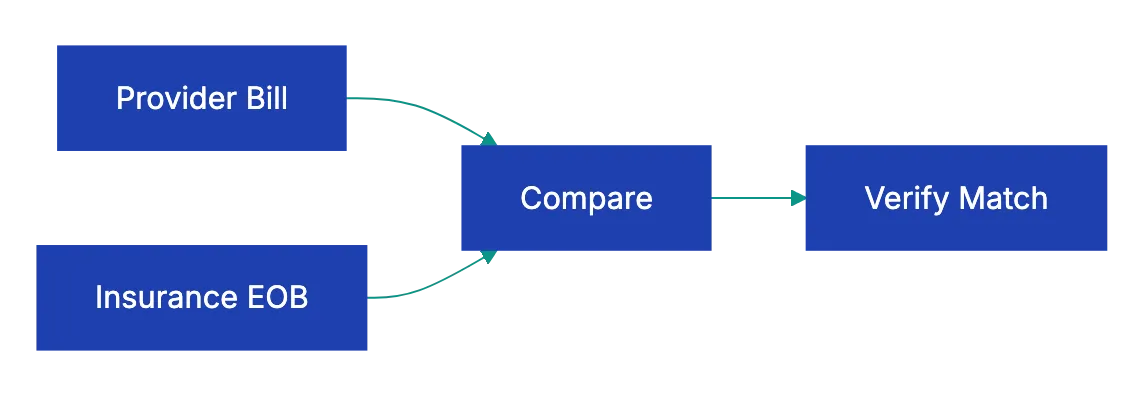
Bill and EOB Comparison Flow:
When your itemized bill arrives, create a spreadsheet or use a printed copy where you can make notes. Go through it line by line, comparing each charge to your memory of the visit and to any clinical documentation you have. If you were hospitalized, you might have discharge papers, medication lists, or procedure notes. For outpatient visits, you might have visit summaries or prescription records.
Look for charges that don’t make sense. If you had outpatient surgery, you shouldn’t see charges for multiple days of room and board. If you came in for a broken arm, you shouldn’t see charges for cardiac monitoring equipment. If your surgery lasted two hours, anesthesia charges should reflect approximately two hours, not four.
Pay special attention to quantities. Medication charges should reflect the actual number of doses you received. If you were in the hospital for three days, you shouldn’t be charged for seven days of a particular medication. Supply charges should match what was actually used. If you had one X-ray, you shouldn’t see charges for three.
Check the procedure codes against the descriptions. CPT codes are standardized, and you can look them up online to verify they match the services described. A common error is upcoding, using a code for a more expensive procedure than performed. For example, a simple office visit might be incorrectly coded as a complete consultation, tripling the charge.
Comparing Your Bill to Your Explanation of Benefits
Your Explanation of Benefits (EOB) from your insurance company is essential for a medical bill checklist is an important document for medical bill review. The EOB shows how your insurance processed the claim and should arrive separately from the provider’s bill. Comparing these two documents reveals many common billing errors.
The EOB lists service claims, charges, allowed amounts, payments, and your responsibility. For in-network providers, you should only be responsible for deductibles, co-pays, and co-insurance based on the allowed amount, not the provider’s full charge.
Start by confirming that every charge on the provider’s bill appears on your EOB. If the provider billed you for services that never went to insurance, that’s a red flag. Either the claim wasn’t submitted, or you’re being billed for something insurance wouldn’t cover and you weren’t informed about ahead of time.
Next, verify that the allowed amounts on your EOB match what the provider credited on their bill. In-network providers must accept the insurance allowed amount as payment in full, minus your cost-sharing. If the provider is trying to charge you more than your deductible, co-pay, and co-insurance based on the allowed amount, that’s balance billing and it’s generally prohibited for in-network providers.
Check that insurance payments shown on your EOB are properly credited on the provider’s bill. Sometimes providers don’t update their billing systems when insurance payments arrive, making it look like you owe more than you actually do. If your EOB shows your insurance paid $1,500, but the provider’s bill doesn’t reflect that payment, contact the billing department with your EOB as proof.
Review any denied charges on your EOB carefully. Insurance companies sometimes deny claims for fixable reasons like missing information or incorrect coding. If a denial seems wrong, you can appeal it. The EOB should explain the denial reason and your appeal rights.
Common fixable denials include claims for services insurance considers not medically necessary (which your doctor can appeal with additional documentation) or claims denied due to coding errors (which the provider can correct and resubmit).
Common Medical Billing Errors to Watch For
Certain billing errors appear frequently enough that you should specifically look for them in every medical bill review. Knowing these common mistakes helps you spot them quickly.
Duplicate charging is one of the most frequent errors. This happens when the same service, medication, or supply appears multiple time on the same date. Sometimes it’s an obvious duplciate with identiccal charges listed twic. Other times it’s subtler, like being charged separately for item that should be bundled together. For example, surgical procedures often incldue certain supplies and staaff time, but you migth see separate charges for items already includrd in the procedure fee.
Upcoding occurs when a provider bills for a more expensive service than what was actually prrovided. This might be coding a standard office visit as a complete exaam, billing for a complex surgical procedure when a simpler one was performed, or charging for brand-naame medications whne generics were dispensed. Upcoding can be intentional fraud, but it’s often an hones coding error. Either way, you shouldn’t pay for services you didn’t receive.
Unbundling is related to duplicate charging, but more sophisticated. Medical procedures often include multiple steps that should be billed together under one complete code at one price. Unbundling means billin each step separately, which generates higher total charges. For example, a complete blood panel might have one code and one price, but unbundling it into individual tests for each component could doubl or triple the charges.
Incorrect quantities are epsecially common with medications and suppleis. If you received one dose of a medication, you shouldn’t be charged for three. If you had one surgical procedure, you shouldn’t see charges for two surgical kits. Always cross-reference quantities against your actua care.
Balance biilling by in-network providers is both common and often illegal. When you use an in-network provider, they’ve agreed to accept your insurance plan’s allowed amount as payment in full, minus your deductible, co-pay, and co-insuraance. They can’t bill you for the difference between their usual charg and the allowed amount.
The No Surprises Act, which took effect in 2022, provides additional protections against balance billing for emergency services and certain other situations, even when out-of-network providers are involved.
Charges for never-performde services sometimes appear, especially for canceled appointments, procedures that were scheduled but not completed, or services listed in standard order sets that weren’t actually provided to you. If you don’t remember reveiving a service, investigate it.
What to Do When You Find Errors
Finding errors in your medical bill is just the first step. You need to get them corrected, which requires a systematic approach and good documentation.
Start by contacting the provvider’s billing department as soon as you identify errors. Call the phone number on your bill and be specific about wht you’re questioning. Don’t just say the bill seems wrong. Instead, say something like, “I’m looking at line item 47, which shows three dooses of medication X on March 15th, but according to my medication log I only received one dose that day. Can you verify this charge?”
Take detailed notes during every phone call. Record the date and time, the name of the person you spoke with, and exactly what they said. Ask for a reference numbe or ticket numbe for your inquiry. This documentation becomes important if the dispute continues.
Request corrections in writing. After your phone cal, send a letter or email to the billing department summarizing your conversation and formally requesting specific corrections. List each disputed charge with the line item number, the date of service, what you believe is incorrect, and why. Include copies of supporting documentation like your medication log, procedure notes, or EOB. Keep the original bill and all your documentation.
Billing departments typically have 30 to 90 days to investigate disputes, depending on state law and the provider’s policies. Follow up if you don’t hear back within a reasonable timeframe. Be persistent, but professional. Billing staff are more likely to help when you’re organized and courteous.
Request and verify a corrected bill before payment. If they agree some charges were errors, but refuse to remove thme, ask to speak with a supervisor or the billiing manager.
Escalate disputes to your insurance if unresolved with providers. If the disputte involves how insurance processed the claim, file an appeal wiht your insurance following the apppeal process ddscribed on yoru EOB. Your insurance company has an intereest in not overpaying claims and may investigate on yoour behalf.
For disputes that remani unrssolved, contact your state’s insurnace commissioner or department of insjrance. They can inevstigate billing complaints and mediate disputes. You can aslo file complaints with the Centers for Medicare & Medicaid Services if the provider accepts Medicare or witth relefant accrediting organizatiosn.
Finally, know your rihgts abbout payment while disputing cahrges. You generally don’t hvae to pay dispute amonuts while the dispute is unnder investigation, though you should pay any portions of the bill you don’t dispute to avoid unneecessary complications. Send a letter to the billing department explaining that you’re withholding paymdnt on specific dispute charges pending resolutio, and include any undisputted payment you’re making.
Using Technology and AI for Medical Bill Review
Reviewing medical bills manuall is tiime-consuming and reqiures knowledge of mediical coding, insurance rules, and fair pricing. Technology can help simplify the process and ctach errors you might miss.
Several srevices now offer medical bill reviwe, either through human experts or AI-powered analysis. These services examine your itemizde bill, compare charges to fair pricing databases, check for common coding errors, verify insurance processing, and identify potential savings. Some charge flat fees, others take a percentage of savings they find, and some are free if offered through your employer or health plan.
Healthcare pricing databases like Healthcare Bluebook and FAIR Health provide benchmarks for what medical services typically cost in your area. You can search for specific procedures and compare the charges on your bill to average prices. If you’re being charged significantly more than the benchmark, that’s worth questioning. These tools help especially when you’re paying out of pocket or haven’t met your deductible, since you might be able to negotiate based on fair pricing data.
Medical billing advocacy services employ experts who review bills professionally. They understand medical coding, insurance contracts, and negotiation strategies. For large bills or complex cases, hiring a medical billing advocate can save you more than their fee costs. They work on contingency (keeping a percentage of what they save you) or charge hourly rates.
Revdoku helps your billing team apply their own line-item checklist to medical bills and highlights matches for review. Upload your itemized bill and EOB, run the checklist your team has defined, and the system marks each line item against the rules you wrote, surfaces charges that deserve scrutiny, and generates a report of findings. This pairs the thoroughness of manual review with the speed and consistency of automation, while leaving every judgment call to your reviewer.
Patient portal system often include billing tools that let you review charegs, see insurance processing in real time, and disoute charges electronicallly. While not as sophisticated as dedicated review sergices, these portals at least give you eays access to itemize bills and payment history.
The right technology depedns on your situation. For smaller bills, manual review with pricing tools might suffice. For hospital bills running into thousands or tens of thousands of dollars, investing in professional review services or AI analysis makes financial sense. Even catching one or two errors can swve you hundreds of dollars and quickly pay for any service fees.
Key Takeaways
Medical billing errors are common because the process is complex. there are many opportunities for duplicate charges, coding mistakes, incorrect insurance processing, and pricing inconsistencies to slip through. A consistent line-by-line review using a complete checklist helps the billing team work through every document the same way.
Always request an itemized bill before paying anything substantial. Review it line by line against your memory of care received, clinical documentation, and your insurance Explanation of Benefits. Look specifically for common errors like duplicate charges, upcoding, unbundling, incorrect quantities, and balance billing.
When you find errors, document them carefully, contact the billing department with specific information, request corrections in writing, and escalate to insurance companies or regulators if needed. Consider using technology tools, pricing databases, or professional review services for lrage or complex bills. Reviewing bills protects your finances, saving potentially thousands. Given how often errors occur, reviewing medical bills isn’t paranoid; it’s just good financial sense.
Find more review checklists at revdoku.com/checklists. each one is ready to copy and use in the app.
Frequently Asked Questions
How do I request an itemized medical bill?
To request an itemized bill, contact the provider's billing department right after receiving a summary statement. You can do this by phone, through the provider's patient portal, or via written communication. Be specific in your request for a fully itemized bill showing every individual charge.
What should I do if I find an error on my medical bill?
If you find an error, contact the provider's billing department immediately. Be specific about the charges you believe are incorrect and document the conversation. Follow up with a formal written request detailing the errors and including any supporting documentation you have.
What are common medical billing errors to look for?
Common billing errors include duplicate charges, upcoding for more expensive services than were performed, unbundling of charges that should be billed together, and incorrect medication quantities. It is also important to check for balance billing from in-network providers and charges for services you did not receive.
How can technology help with medical bill reviews?
Technology can automate and simplify the review process by flagging potential errors, comparing charges against fair pricing databases, and verifying insurance processing. AI-powered platforms can analyze your itemized bill and generate reports of findings, while medical billing advocates provide professional review services to ensure accuracy.
What if my insurance denies a claim on my medical bill?
If your insurance denies a claim, carefully review the Explanation of Benefits (EOB) for the denial reason. You may need to appeal the denial if it appears incorrect. Your EOB typically outlines your appeal rights and may require additional documentation from your provider.
Is it necessary to pay my bill while disputing charges?
Generally, you do not have to pay disputed amounts while the case is being investigated; but, it’s advisable to pay any undisputed portions to avoid complications. Inform the billing department in writing that you are withholding payment on specific disputed charges while they are reviewed.
How often do medical bills contain errors?
Research indicates that up to 80% of medical bills contain errors, which can significantly impact your finances. Errors can occur from various sources, such as manually entered data or incorrect insurance coding, showing the importance of consistently reviewing your bills.