
Essential Lease Review Checklist for Tenants
How to use this lease checklist
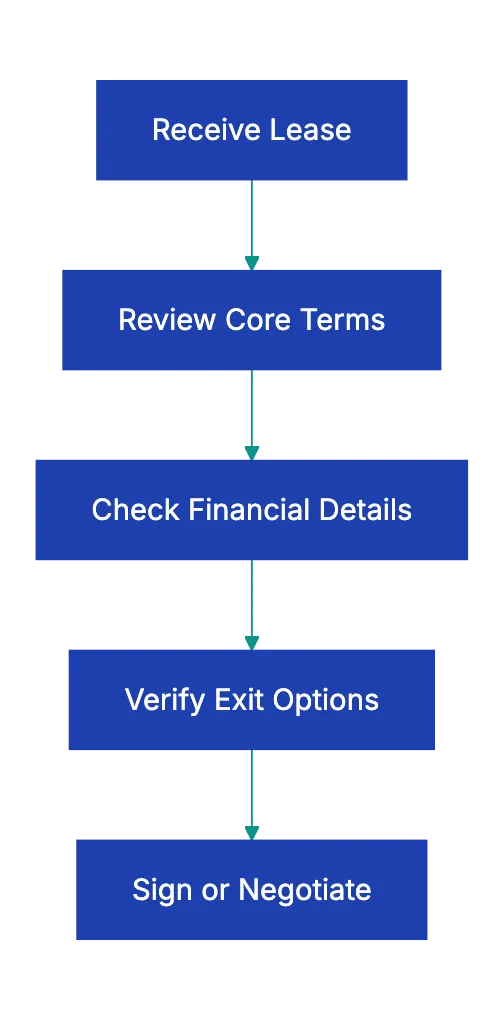
Read the whole lease before you sign it, also the attachments and the building rules. Go through the checklist below. Write down each item that is missing, unclear or different from what the landlord told you. Then ask for changes in writing before you sign.
State and local laws give tenants many rights, and a lease clause cannot always remove them. The rules differ from state to state. This article gives examples from California, New York and Washington. Look up the rules for your own state and city.
Parties, property and term
- The lease gives the full legal name of each tenant. It also names the landlord or the owner, not only the property manager.
- The address includes the unit number. The lease names any parking space or storage unit that comes with the rental.
- The start date and the end date are correct.
- The renewal terms are clear. Look for an automatic renewal clause and the deadline to give notice.
Rent, deposit and fees
- The lease gives the monthly rent, the due date, the accepted payment methods and any grace period.
- Late fees are a fixed amount or a fixed percentage, not “at the landlord’s discretion.” Some states set a limit. In New York, a landlord can charge a late fee only after rent is five days late. The fee cannot be more than $50 or 5% of the monthly rent, whichever is less (NY Real Property Law 238-a).
- The lease gives the security deposit amount, the reasons for deductions and the deadline for its return. In California, a security deposit is refundable. Since July 1, 2024, most landlords can ask for no more than one month of rent. The landlord must return the deposit, with an itemized list of deductions, within 21 days after move-out (California Attorney General).
- The lease lists every other charge, for example pet fees, parking, amenities, administration and application fees.
- The lease says which utilities you pay: water, sewer, trash, gas, electricity and internet.
Repairs and changes to the home
- The lease says who repairs what. The landlord usually handles the structure, heating, plumbing and appliances. The tenant usually handles small items such as light bulbs.
- The lease says how to report a repair and whom to call in an emergency.
- Repair times are clear. Some states set them by law. In Washington, after written notice, the landlord must start repairs within 24 hours for loss of water, heat or electricity. The limit is 72 hours for a broken refrigerator, range or major plumbing fixture, and 10 days for other repairs (RCW 59.18.070).
- The lease says which changes you can make, for example paint, shelves or a smart lock. If you plan a change, get written permission first.
Entry, privacy and house rules
- The lease says how much notice the landlord gives before entry, and for which reasons. In California, a landlord generally must give 24 hours of written notice and enter during normal business hours. Emergencies are an exception (Santa Clara County Superior Court).
- The rules for guests and for additional occupants fit your plans.
- The pet rules cover your pets: type, size, number and fees.
- The rules for parking, quiet hours and smoking are acceptable to you.
- You know if the lease requires renter’s insurance, and the minimum coverage.
Moving out and ending early

- The lease says what happens if you leave early. Some leases have a fixed buyout fee. Others make you pay rent until a new tenant moves in.
- You know the notice period for move-out or non-renewal and how to give notice. Put the deadline in your calendar on the day that you sign.
- The lease says if you can sublet or assign the lease. Subletting means that another person rents from you. Assignment means that another person takes over your lease.
- The lease says what happens if the owner sells the property.
- You know how the move-out inspection works. In California, the landlord must tell you about your right to an inspection before move-out. If you ask for one, it takes place in the two weeks before you leave.
- Before you move in, you and the landlord sign a list of the condition of each room. Take dated photos of each room and each defect. The list and the photos protect your deposit at move-out.
Red flags
These clauses are reasons to ask for a change, to get advice or to walk away:
- The lease says that you accept the home “as is” and gives up your right to repairs. In California, the landlord must repair health and safety problems, such as broken plumbing or heating (California Attorney General).
- The lease calls part of the security deposit “non-refundable.” In California, a security deposit is refundable.
- The landlord can enter “at any time” without notice.
- Late fees have no limit, or they add up each day.
- You pay the attorney fees of the landlord in any dispute, even if you win.
- An automatic renewal clause has a long notice period in small print.
- The lease forbids “any alterations” and does not define them.
- A promise from the landlord is not in the written lease. If a promise is not in the lease, it is hard to enforce.
Extra items for a commercial lease
A commercial lease usually gives the tenant fewer legal protections than a home lease, and the amounts are larger. Add these items:
- The permitted use clause covers your business now and the changes that you plan, for example a coffee shop that later sells food.
- You know the rent structure. In a triple net (NNN) lease, the tenant pays base rent plus a share of property taxes, insurance and maintenance.
- The lease defines common area maintenance (CAM) charges, your share of the costs for shared areas. It says how the landlord calculates them, limits their yearly increase, and gives you a right to audit them. Ask if the landlord can pass on the cost of a new roof or a new parking lot.
- The tenant improvement allowance is clear: the amount, when the landlord pays it, who chooses the contractors, and who pays costs above the allowance.
- The rent increases are fixed, for example 3% each year, or tied to the Consumer Price Index. Renewal options say how the landlord sets the new rent. “Fair market value” can mean a large increase.
- You have the sign rights that your business needs, on the building and in the windows.
- An exclusivity clause stops the landlord from renting to a direct competitor in the same property, if you need that. Look for any clause that stops you from opening a second location nearby.
- A personal guarantee makes you personally liable for the rent if the business cannot pay. If the lease has one, try to limit the amount or the time.
- You know the insurance types, the coverage limits and the additional insured parties that the lease requires.
Ask a lawyer who works on landlord-tenant law to read a commercial lease before you sign it. Do the same for a home lease with large sums or unusual clauses.
Use this checklist with Claude or ChatGPT
You can use this checklist with a general AI assistant, such as Claude or ChatGPT. Paste the checklist and the text of the lease, or upload the lease as a file. Tell the assistant your state and city. Then ask it to go through each item and to list what is missing or unusual. Here is an example prompt:
Below is a lease review checklist, followed by a residential lease for
an apartment in [city, state].
For each checklist item, quote the clause and its section number that
covers it, or write "NOT IN LEASE".
Then list every clause that is one-sided, vague or unusual, and write
a question that I can ask the landlord about each one.
Compare each finding with the lease before you act on it. The assistant can misread a clause, miss one, or state a law that does not apply in your state. For a legal decision, a local tenant organization or a lawyer has the final word.
Remove your Social Security number, bank details and signatures before you upload the lease. The service keeps a copy of what you upload, so look at the data settings of your workspace.
A docs portal with Ask AI
and support tickets
Connect a repository, or describe your product to start. Each docs site has search, Ask AI, an API console, an MCP server and support tickets.
- Publishes from GitHub on every push
- Works with Mintlify repositories
- API console from your OpenAPI file
- MCP server and llms.txt for AI agents
- Ask AI and support tickets
- Analytics for people and AI agents
Frequently Asked Questions
Can the landlord change the rent or the terms after I sign?
During a fixed-term lease, a change usually needs the written agreement of both sides. In a month-to-month tenancy, the landlord can change terms with written notice, and state law sets the notice period. In California, for example, a rent increase needs at least 30 days of written notice, or 90 days if the increase is more than 10%.
What can I do if the landlord keeps my deposit without a valid reason?
Ask the landlord in writing for the deposit and the itemized list of deductions. If that does not work, you can file a claim in small claims court. In California, if the landlord acted in bad faith, a court can award your actual loss plus up to twice the amount of the deposit.