
Why Grant Proposals Fail: Common Mistakes to Avoid
The mistakes that sink most grant proposals
Many grant proposals fail for clerical reasons, not because of weak ideas. A funder can return an application without review if it breaks a format rule or misses an attachment. NIH, for example, can withdraw an application if its attachments break the NIH rules for font size and spacing (NIH format rules).
The rules for each grant are in its notice of funding opportunity (NOFO), the announcement from the funder. Foundations use other names, such as “request for proposals” or “guidelines.” This article uses “the notice” for all of them.
| Mistake | How to find it before the funder does |
|---|---|
| The SAM.gov registration expired | Renew it every year and start new registrations weeks early |
| The sections are not in the order of the notice | Copy the section headings from the notice into your draft |
| The page limit or the font rule is broken | Measure the final PDF, not the word processor file |
| The budget and the narrative do not agree | Match each budget line to an activity in the narrative |
| The totals have math errors | Use spreadsheet formulas, then add the totals again by hand |
| The indirect cost rate is wrong | Use your negotiated rate, or the de minimis rate that the rules allow |
| A required attachment is missing | Make a list of every attachment that the notice names |
| The space for each section does not match its points | Give more space to the review criteria that have more points |
| The submission is late or fails | Submit days before the deadline and make sure that the funder received it |
The checklist below covers each of these points. The registration items apply to US federal grants. The other items apply to most federal and foundation grants.
Registrations (US federal grants)
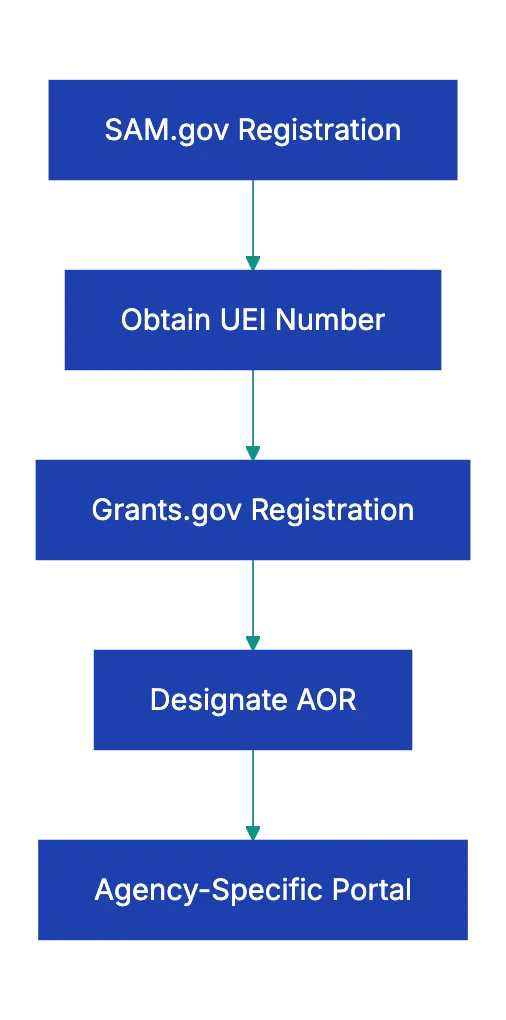
- Your organization has an active registration in SAM.gov. You must renew it every year (Grants.gov).
- You know your Unique Entity ID (UEI), the ID that SAM.gov gives your organization. The UEI replaced the DUNS number on April 4, 2022.
- The legal name and the address of the organization are the same in SAM.gov and on the SF-424, the standard federal application form.
- Your organization has a Grants.gov account. At least one person has the AOR (Authorized Organization Representative) role. Only users with an AOR role, or a custom role with permission to submit, can submit an application (Grants.gov).
- If the agency uses its own system, the correct people have accounts in it. For example, NIH uses eRA Commons, and NSF uses Research.gov.
- You started each new registration early. Grants.gov says that a SAM.gov registration can take up to 10 business days to become active. It can take weeks or months if SAM.gov cannot match your information to official records.
- One shared document lists each portal, the owner of each login and each renewal date.
Project narrative
- The sections follow the order and the headings in the notice.
- The narrative answers each review criterion. Each section gets space in proportion to its points.
- The need statement uses recent, local and specific data, with sources. For example: “In [county], [X]% of children under 5 live below the federal poverty line, compared with [Y]% in the state.”
- Each objective is SMART: specific, measurable, achievable, relevant and time-bound. For example: “By June 2028, raise the share of participating students who read at grade level from 35% to 55% on the state test.”
- The narrative stays within the page limit and follows the format rules for font, margins and spacing. NIH, for example, requires text of 11 points or larger and margins of at least half an inch.
- The evaluation plan says what you will measure, how and when.
- If the notice asks for a logic model, the application includes one. A logic model is a diagram of inputs, activities, outputs and outcomes.
Budget and budget justification

- Each budget line connects to an activity in the narrative. Each activity with a cost has a budget line.
- Each salary line shows the calculation: annual salary x percent of effort x months worked / 12. For example: $65,000 x 50% x 12/12 = $32,500.
- The line items add up to the category totals, and the category totals add up to the total request.
- The total request is the same on the SF-424, in the budget forms and in the narrative.
- The indirect cost rate is correct. Indirect costs are shared costs, such as rent and administration, that do not belong to one project. For a federal award, use your negotiated rate. Without a negotiated rate, you can use a de minimis rate of up to 15% of modified total direct costs (2 CFR 200.414(f)). Modified total direct costs leave out some items, such as equipment. Older guides say 10%. A foundation can set its own limit.
- If the funder requires cost share, the budget shows each amount and its source. Cost share is the part of the project cost that your organization or partners pay.
- The budget justification explains why the project needs each cost and how you estimated it.
Attachments
- A list gives each attachment that the notice requires, with an owner and an internal due date for each.
- Each letter of support comes from a named partner and says what the partner will do or give. Ask partners at least three weeks before the deadline.
- The biographical sketches use the format of the funder. NIH and NSF both require biographical sketches that you prepare in SciENcv (NIH, NSF).
- If the funder asks for proof of nonprofit status, the application includes the IRS determination letter.
- If the funder asks for an audit, the application includes the most recent one. Federal rules require an audit from an organization that spends $1,000,000 or more in federal awards in one fiscal year (2 CFR 200.501). Older guides say $750,000.
- The file names, file types and page limits follow the notice.
Submission
- Plan to submit days before the deadline. Grants.gov advises you to submit well before the deadline in case of a submission error.
- In Grants.gov, select Check Application on the Forms tab before you submit. Correct each error that it shows.
- After you submit, use Check Application Status to make sure that the agency received the application.
- Keep the tracking number and every confirmation email.
- A person who did not write the proposal reads it against the review criteria before submission.
- If you start from an earlier proposal, you rewrote it for the priorities and rules of this funder.
Use this checklist with Claude or ChatGPT
You can use this checklist with a general AI assistant, such as Claude or ChatGPT. Paste the checklist, the notice and your draft. Then ask the assistant to go through each item and to list what is missing. Here is an example prompt:
Below are a grant notice, a grant proposal checklist and our draft.
1. Make a table of every required section, page limit, format rule,
   attachment and review criterion in the notice. For each one, give
   the part of our draft that meets it, or "MISSING".
2. List every budget line that has no matching activity in the
   narrative, and every activity with a cost that has no budget line.
3. List every figure that appears in more than one place, and say if
   the values agree.
Compare each finding with the notice before you act on it. The notice is the authority, and the assistant can miss a rule or invent one. Do the budget math again yourself. The assistant also cannot see your registration status in SAM.gov or Grants.gov.
Read the AI policy of the funder before you use AI on an application. NIH, for example, does not consider an application that AI substantially wrote to be the original idea of the applicant (NOT-OD-25-132). Use the assistant to review your draft, not to write it.
Remove personal data before you upload, for example staff salaries and home addresses in letters. The service keeps a copy of what you upload, so look at the data settings of your workspace.
A docs portal with Ask AI
and support tickets
Connect a repository, or describe your product to start. Each docs site has search, Ask AI, an API console, an MCP server and support tickets.
- Publishes from GitHub on every push
- Works with Mintlify repositories
- API console from your OpenAPI file
- MCP server and llms.txt for AI agents
- Ask AI and support tickets
- Analytics for people and AI agents
Frequently Asked Questions
Do I need a SAM.gov registration for a foundation grant?
SAM.gov registration is for federal awards. A private foundation sets its own requirements, so read its guidelines. If a state agency or another organization passes federal money on to you, read its notice for the registration that it requires.
What is the difference between the budget and the budget justification?
The budget gives the numbers by category. The budget justification, also called the budget narrative, explains each number. It says what the cost pays for, why the project needs it and how you calculated it.