
The Ultimate Contract Review Checklist for Business Owners
Table of Contents
- Introduction
- Sample Contract Review Checklist Table
- Parties and Basic Terms
- Financial Terms
- Exit and Renewal
- Intellectual Property and Restrictions
- Dispute Resolution and Legal
- Final Verification
- Understanding Why Contract Review Matters
- The 20-Point Contract Review Checklist
- 1. Are All Parties Correctly Identified?
- 2. Is the Effective Date and Term Clearly Stated?
- 3. Are Deliverables and Scope Described in Specific Terms?
- 4. Are Payment Terms Crystal Clear?
- 5. Are There Hidden Fees or Price Escalation Clauses?
- 6. What Are the Termination Provisions?
- 7. Is There an Auto-Renewal Clause?
- 8. What Are the Liability Caps and Indemnification Requirements?
- 9. Who Owns the Intellectual Property?
- 10. Are Non-Compete or Non-Solicitation Terms Reasonable?
- 11. What Does the Confidentiality Clause Cover?
- 12. What’s the Dispute Resolution Process?
- 13. Which Jurisdiction’s Law Governs?
- 14. Are There Force Majeure Provisions?
- 15. Are Warranties and Guarantees Clearly Stated?
- 16. Is There an Insurance Requirement?
- 17. Are Assignment and Subcontracting Rights Addressed?
- 18. Are Notice Provisions Specified?
- 19. Is There an Entire Agreement Clause?
- 20. Are Signature Blocks Complete?
- Common Contract Review Mistakes to Avoid
- How to Review a Contract Efficiently
- Tools That Speed Up Contract Review
- When to Get Legal Help
- Real-World Examples of Contract Review Saving Money
- Adapting This Checklist for Different Contract Types
- Building Your Own Contract Review System
- Key Takeaways
- Introduction
- Understanding Why Contract Review Matters
- The 20-Point Contract Review Checklist
- 1. Are All Parties Correctly Identified?
- 2. Is the Effective Date and Term Clearly Stated?
- 3. Are Deliverables and Scope Described in Specific Terms?
- 4. Are Payment Terms Crystal Clear?
- 5. Are There Hidden Fees or Price Escalation Clauses?
- 6. What Are the Termination Provisions?
- 7. Is There an Auto-Renewal Clause?
- 8. What Are the Liability Caps and Indemnification Requirements?
- 9. Who Owns the Intellectual Property?
- 10. Are Non-Compete or Non-Solicitation Terms Reasonable?
- 11. What Does the Confidentiality Clause Cover?
- 12. What's the Dispute Resolution Process?
- 13. Which Jurisdiction's Law Governs?
- 14. Are There Force Majeure Provisions?
- 15. Are Warranties and Guarantees Clearly Stated?
- 16. Is There an Insurance Requirement?
- 17. Are Assignment and Subcontracting Rights Addressed?
- 18. Are Notice Provisions Specified?
- 19. Is There an Entire Agreement Clause?
- 20. Are Signature Blocks Complete?
- Sample Contract Review Checklist Table
- Common Contract Review Mistakes to Avoid
- How to Review a Contract Efficiently
- Tools That Speed Up Contract Review
- When to Get Legal Help
- Real-World Examples of Contract Review Saving Money
- Adapting This Checklist for Different Contract Types
- Building Your Own Contract Review System
- Key Takeaways
Introduction
Signing without reading is like buying a house without checking for leaks. Most people do just that. They skim a few pages, trust the other party, and sign away rights they didn’t know they had. Small business owners often find themselves in five-year agreements mistaken for annual. Freelancers who built entire products only to find out the client owned every line of code. Managers who discovered non-compete clauses that prevented them from working in their industry for two years. Instead of hiring a lawyer for every contract, It’s developing a systematic approach to reviewing contracts yourself. This contract review checklist walks you through 20 specific things to check before you sign any agreement, written for people who aren’t lawyers but need to protect themselves anyway.
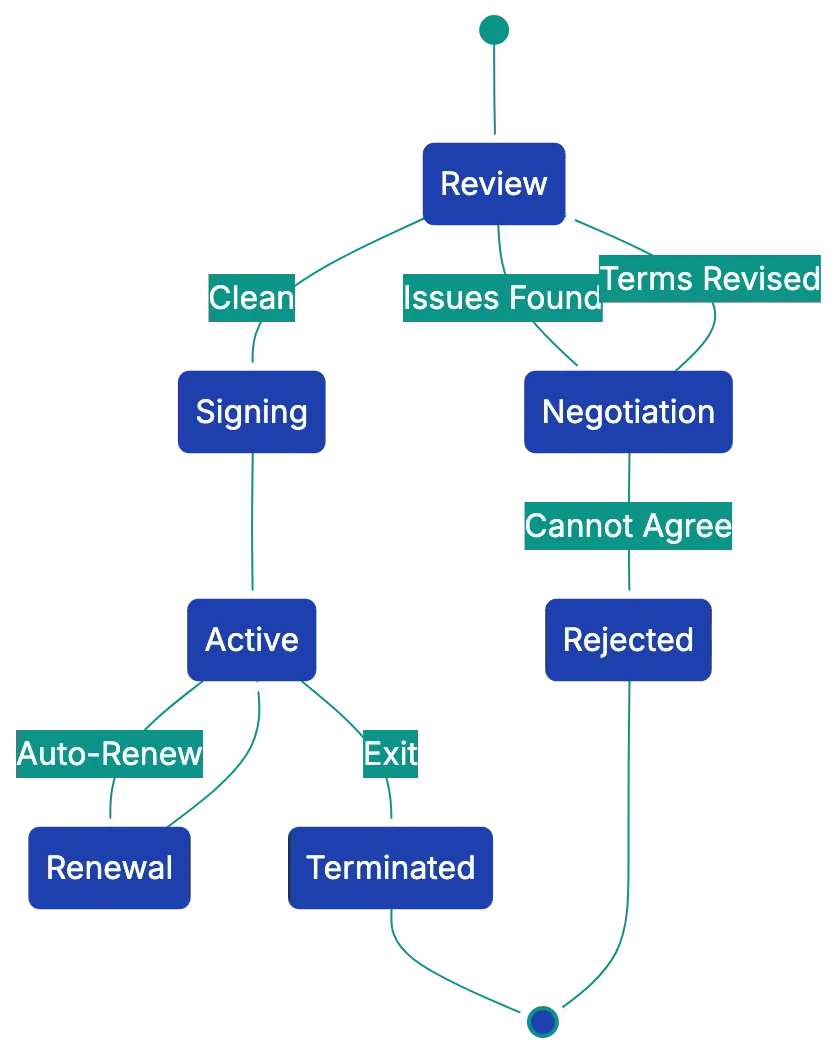
Contract Lifecycle States:
Sample Contract Review Checklist Table
Parties and Basic Terms
- Party Identification: Full legal names, entity types, addresses
- Effective Date & Term: Start date, end date, duration
- Scope & Deliverables: Specific, measurable descriptions
Financial Terms
- Payment Terms: Amount, schedule, method, currency
- Hidden Fees: Setup, processing, administrative charges
- Liability Caps: Limits on damages, indemnification scope
- Insurance: Required coverage types and amounts
- Warranties: What’s guaranteed and for how long
Exit and Renewal
- Termination Rights: Notice period, termination for convenience
- Auto-Renewal: Renewal terms and opt-out window
- Assignment Rights: Who can transfer the contract
- Subcontracting: Who actually does the work
Intellectual Property and Restrictions
- IP Ownership: Who owns created work and when
- Non-Compete: Geographic scope, duration, industry
- Confidentiality: What’s confidential, duration, exceptions
Dispute Resolution and Legal
- Dispute Resolution: Arbitration, litigation, or mediation
- Governing Law: Which state or country law applies
- Force Majeure: Covered events and payment obligations
- Notice Requirements: How to send formal communications
Final Verification
- Entire Agreement: Confirm this is the complete deal with merger clause
- Signature Blocks: Names, titles, dates, and signing authority
Understanding Why Contract Review Matters
Most contract disasters happen in slow motion, which is why a thorough contract review checklist matters. You sign something on a Tuesday, and months later, you’re disputing service payments, ownership, or auto-renewal efforts. The cost of these mistakes adds up fast. For a ,000 business, that’s ,000 lost.
Contracts are binding. Courts generally assume that if you signed it, you read it and agreed to it. Saying “I missed that” doesn’t void a contract. That’s why learning how to review a contract properly is worth the time investment. An hour with this list can save thousands and months of headaches. Trusting the other party’s fairness is often expensive.
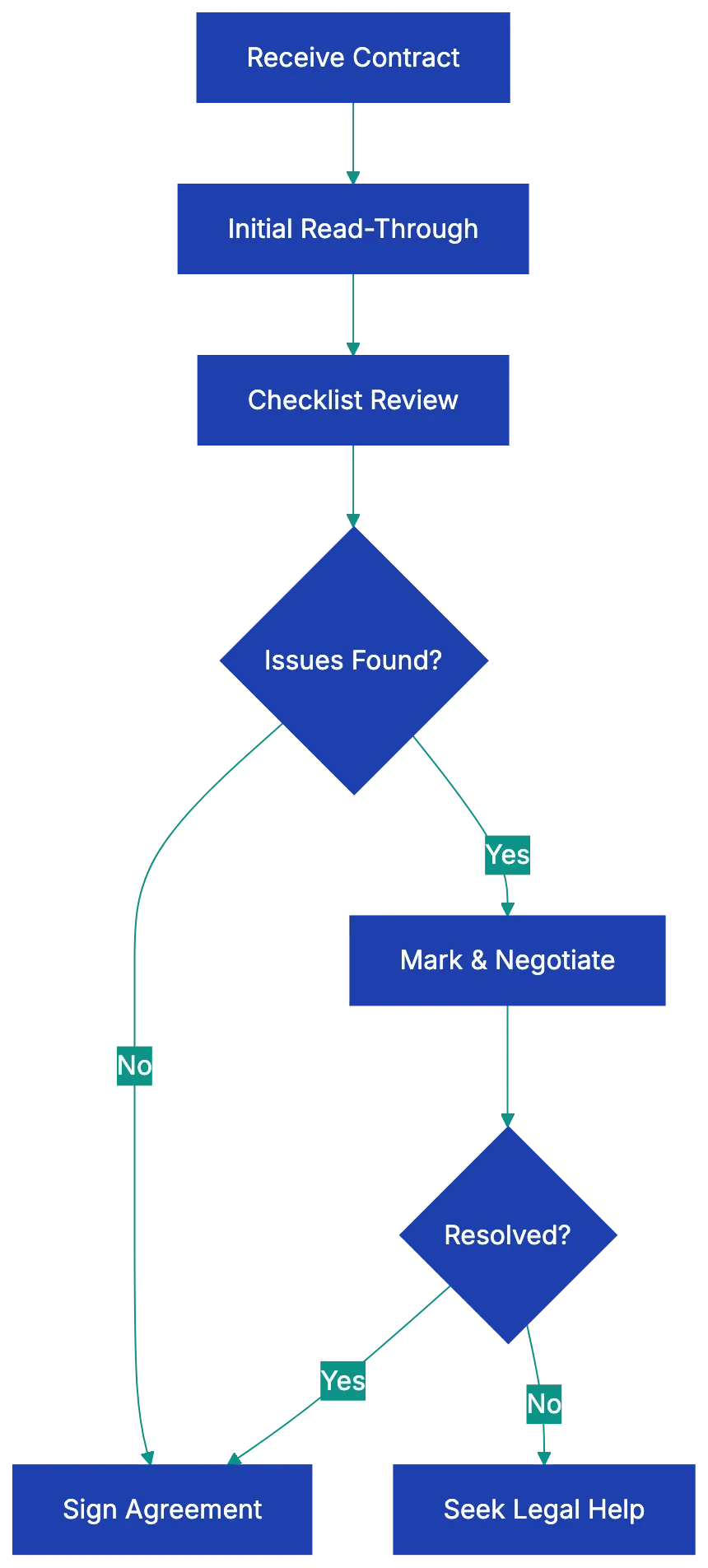
Contract Review Process Flow:
The 20-Point Contract Review Checklist
Here’s your complete contract checklist before signing. Each point includes what to look for in a contract and what goes wrong when you miss it. This checklist works for vendor agreements, service contracts, employment offers, partnership deals, and most business contracts.
1. Are All Parties Correctly Identified?
Check that every party’s full legal name appears in the contract, along with their entity type. If you’re a sole proprietor, that’s your personal name. If you’re an LLC, it should say “ABC Company, LLC,” not just “ABC Company.” The address for each party should be included. What goes wrong: If the legal names are wrong or incomplete, the contract might not be enforceable, or unintentionally guarantee company obligations.
2. Is the Effective Date and Term Clearly Stated?
Look for when the contract starts and how long it lasts. Contracts may start when signed or on a specific date. The term might be one year, month-to-month, or perpetual. What goes wrong: Without clear dates, you won’t know when obligations begin or end, making it impossible to plan or budget properly.
3. Are Deliverables and Scope Described in Specific Terms?
The contract should spell out exactly what’s being delivered or what services will be performed. Vague language like “consulting services” or “marketing support” invites disputes. Look for measurable specifics like “20 hours per month of financial consulting” or “development of a mobile app with features listed in Exhibit A.” What goes wrong: Vague scope leads to endless arguments about whether the work was actually done and what’s included versus extra.
4. Are Payment Terms Crystal Clear?
You need to know the exact amount, when it’s due, how to pay it, what currency, and any late fees. Is it ,000 upfront or ,000 per month for five months? Due on the first or net 30? Wire transfer or check? What goes wrong: Unclear payment terms create cash flow problems and billing disputes that damage business relationships.
5. Are There Hidden Fees or Price Escalation Clauses?
Read carefully for setup fees, processing fees, administrative charges, or annual price increases. Some contracts include clauses that let the other party raise prices based on inflation or at their discretion. What goes wrong: That monthly service becomes after annual increases you didn’t budget for, or you get hit with surprise fees that make the deal unprofitable.
6. What Are the Termination Provisions?
How can each party end the agreement? Is there a termination for convenience clause, or can you only exit for cause? How much notice is required? Are there termination fees or wind-down obligations? What goes wrong: You find you’re locked in for years with no exit, or that leaving early costs thousands in penalties.
7. Is There an Auto-Renewal Clause?
Many contracts automatically renew for another term unless you cancel within a specific window, often 30 to 90 days before the end date. What goes wrong: You miss the cancellation deadline and get locked in for another full term, even though you wanted to switch vendors months ago.
8. What Are the Liability Caps and Indemnification Requirements?
Liability provisions limit how much each party can be sued for if something goes wrong. Indemnification clauses require one party to cover the other’s legal costs and damages in certain situations. What goes wrong: You agree to unlimited liability or to indemnify the other party for things outside your control, exposing yourself to catastrophic financial risk.
9. Who Owns the Intellectual Property?
If the contract involves creating anything, who owns it? This includes code, designs, writing, inventions, processes, or trade secrets. Does ownership transfer upon payment, or does the creator retain it and grant a license? What goes wrong: You pay to build something custom and find the vendor owns it, or you create work as a contractor and the client can prevent you from using similar approaches for other clients.
10. Are Non-Compete or Non-Solicitation Terms Reasonable?
Non-compete clauses restrict your ability to work in the same industry or geography for a period after the contract ends. Non-solicitation prevents you from hiring the other party’s employees or stealing their clients. What goes wrong: You agree to restrictions so broad you can’t work in your field for years, or you innocently hire someone and face a lawsuit.
11. What Does the Confidentiality Clause Cover?
Most contracts include confidentiality or NDA terms. Check what information is considered confidential, how long the obligation lasts, and what exceptions exist for information that’s already public or independently developed. What goes wrong: You’re prohibited from discussing basic industry practices or using general knowledge from the engagement, or you accidentally breach by sharing something you didn’t realize was confidential.
12. What’s the Dispute Resolution Process?
Contracts specify how disagreements get resolved. Check each element carefully:
- Litigation: court-based resolution in the specified jurisdiction
- Binding arbitration: private dispute resolution outside the court system
- Mediation: non-binding third-party facilitation before escalating
The contract will also specify which state or country’s courts have jurisdiction. What goes wrong: You end up in arbitration that costs more than the contract is worth, or you have to sue in a state across the country where the other party is located.
13. Which Jurisdiction’s Law Governs?
This clause determines which state or country’s laws interpret the contract. It’s often wherever the other party is located. What goes wrong: You’re subject to laws you don’t understand that may be less favorable than your home jurisdiction, making it harder and more expensive to enforce your rights.
14. Are There Force Majeure Provisions?
Force majeure clauses excuse performance when extraordinary events beyond anyone’s control occur, like natural disasters, wars, or pandemics. Check what events qualify and what happens to payments and obligations. What goes wrong: You’re required to keep paying even though the other party can’t deliver due to circumstances they couldn’t control, or vice versa.
15. Are Warranties and Guarantees Clearly Stated?
What promises is each party making? Is the product guaranteed to work as described? Are services warranted to meet professional standards? How long do warranties last? What goes wrong: You assume the product is guaranteed but find it’s sold “as is” with no recourse if it doesn’t work.
16. Is There an Insurance Requirement?
Some contracts require one or both parties to maintain certain types of insurance at specific coverage levels, like general liability or professional liability. What goes wrong: You’re contractually required to buy expensive insurance you don’t have, or the other party has no insurance when their mistake damages you.
17. Are Assignment and Subcontracting Rights Addressed?
Assignment clauses determine whether either party can transfer their rights and obligations to someone else. Subcontracting provisions control whether work can be delegated to third parties. What goes wrong: The company you chose to work with sells the contract to a different company you wouldn’t have selected, or work you expected would be done in-house gets outsourced.
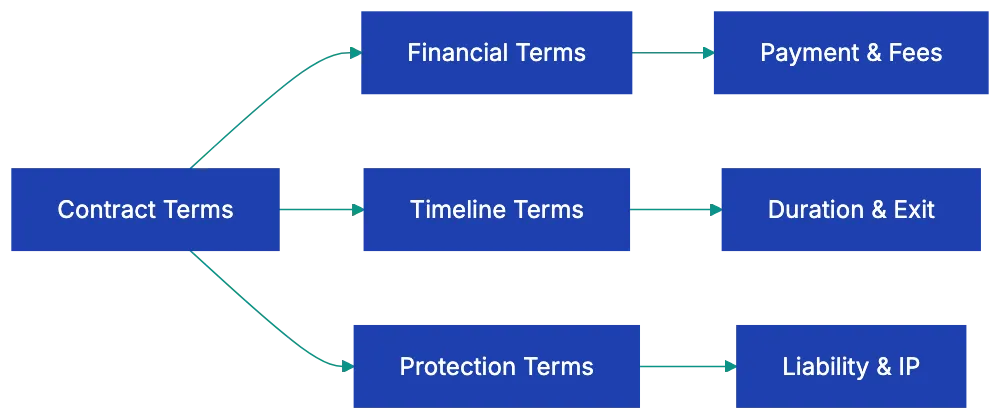
Critical Contract Elements Overview:
18. Are Notice Provisions Specified?
Contracts typically require formal communications like termination notices or breach notifications be delivered in specific ways, such as certified mail to specific addresses or email to designated contacts. What goes wrong: You send a cancellation email that doesn’t count as proper notice, missing your termination window and getting stuck for another term.
19. Is There an Entire Agreement Clause?
This clause, sometimes called a merger clause, states that the written contract contains the complete agreement and supersedes all prior discussions, emails, and verbal promises. What goes wrong: Promises made during negotiations that aren’t in the final contract are unenforceable, and you can’t prove they were part of the deal.
20. Are Signature Blocks Complete?
Each signature block should include the signer’s printed name, title, and date. For companies, the signer should have authority to bind the entity. What goes wrong: Someone without authority signs, making the contract invalid, or missing dates create confusion about when obligations begin.
Common Contract Review Mistakes to Avoid
The biggest mistake people make when reviewing contracts is skipping it entirely. They assume the other party wrote something fair or that standard contracts are safe. Standard doesn’t mean fair. It means standard for that company, written by their lawyers to protect their interests. Another common error is reading only the first few pages. The dangerous stuff usually lives in the middle sections or the small print attachments. I’ve seen people miss entire exhibits that radically changed what they thought they were agreeing to.
Another trap is failing to negotiate. Many people think contracts are take-it-or-leave-it, but most business contracts are negotiable to some degree. If you spot something unreasonable in your contract review, mark it and ask for changes. The worst they can say is no, and you’ll have tried. Conversely, asking to change everything makes you difficult to work with. Pick your battles and focus on terms that actually matter to your situation. Finally, don’t sign anything with blanks or “to be determined” sections. Those should be filled in before you commit, or you’re giving the other party the power to decide them later.
How to Review a Contract Efficiently
Start by reading the entire contract once without marking anything, just to understand the overall deal. This prevents you from getting lost in details and missing the big picture. On your second pass, work through this review contract checklist, marking sections that seem unclear or unfavorable. Use the table above as a literal checklist, verifying each point and noting anything concerning. For complex or high-value contracts, create a summary document listing key terms like payment amounts, dates, termination rights, and liability caps. This makes it easier to compare multiple vendor proposals or remember what you agreed to six months later.
When you spot something you don’t understand, don’t skip it. That’s usually where problems hide. Look up unfamiliar terms or ask the other party to explain in plain language. If they can’t or won’t explain something clearly, that’s a warning sign. For significant contracts like employment agreements, partnership deals, or anything over a few thousand dollars, having a lawyer review it is worth the investment. A good lawyer will spot issues you missed and can negotiate better terms. Think of legal review as insurance, not an expense.
Tools That Speed Up Contract Review
Manually checking contracts against a checklist works, but takes time. Modern AI-powered contract review tools can analyze agreements in seconds, flagging common issues and comparing terms against your checklist. While it won’t replace reading the contract yourself or getting legal advice for major deals, it catches things human eyes miss when you’re tired or in a hurry.
Other approaches include building templates for contracts you use repeatedly. If you frequently hire contractors, create a services agreement with your preferred terms, so you’re negotiating from your paper instead of theirs. Maintain a swipe file of good contract language for common clauses. When you negotiate a favorable termination clause or IP ownership term, save it to reuse in future agreements. Over time, you’ll build a library of known-good language that makes both drafting and reviewing faster.
When to Get Legal Help
Some contracts deserve professional legal review regardless of how good your checklist is. Employment agreements with non-competes, equity grants, or unusual provisions should be reviewed by an employment lawyer. Partnership agreements or operating agreements for new businesses need proper legal drafting to avoid catastrophic problems later. Real estate contracts, whether buying commercial property or signing a long-term lease, involve too much money and complexity to wing it. Any contract where you’re personally guaranteeing business debts or taking on significant liability exposure deserves legal eyes.
The cost of legal review varies widely, but expect to pay anywhere from ** to ,500** for a lawyer to review a standard business contract, depending on complexity and your location. That sounds like a lot until you compare it to the cost of getting locked into a bad five-year deal or fighting a lawsuit over ambiguous contract terms. For ongoing business relationships, consider establishing a relationship with a business lawyer who can review contracts on short notice. Some lawyers offer monthly retainer arrangements that include a certain number of contract reviews, making the cost more predictable.
Real-World Examples of Contract Review Saving Money
A marketing consultant I know was thrilled when a major client offered her a year-long contract worth ,000. When she reviewed the payment terms carefully, she discovered they were net-60, meaning she wouldn’t get paid until 60 days after submitting each invoice. With monthly billing, she’d be carrying two months of unpaid work at all times, creating a serious cash flow problem for her small business. She negotiated net-30 terms instead, improving her cash position by ,000. She almost missed it because she was excited about the total contract value.
Another example involved a software company signing a vendor agreement for cloud hosting. The contract included an auto-renewal clause with a 90-day cancellation window. Two years in, they found a better, cheaper provider, but missed the cancellation deadline by three weeks. They were stuck paying for the old vendor for another full year while also paying the new one, losing ,000. The following year they set a calendar reminder for 100 days before renewal and successfully switched. That’s a ,000 lesson in reading termination provisions carefully.
A freelance designer built an entire brand identity for a startup, including logo, website design, and marketing materials. The contract included a clause stating all intellectual property belonged to the designer until final payment was received. The startup ran into funding problems and couldn’t pay the final ,000 invoice. Because the designer had negotiated clear IP ownership terms, she retained rights to the work and could legally prevent them from using it until they paid. Without that clause, she would have been owed money with no recourse. She eventually got paid in full.
Adapting This Checklist for Different Contract Types
While this contract signing checklist covers general business agreements, different contract types need special attention in certain areas. For vendor or supplier agreements, focus extra attention on payment terms, service level agreements, termination rights, and liability caps. For employment contracts, scrutinize non-compete clauses, IP assignment provisions, severance terms, and equity vesting schedules. Partnership or operating agreements demand careful review of profit distribution, management authority, capital contribution requirements, and exit provisions.
Lease agreements, whether for office space or equipment, require close attention to renewal terms, rent escalation clauses, maintenance responsibilities, and default provisions. Non-disclosure agreements need review of what’s considered confidential, how long the obligation lasts, and what exceptions exist. Independent contractor agreements should clearly address IP ownership, payment terms, deliverables, and the classification of the relationship to avoid worker misclassification problems. Tailor your review to emphasize the checkpoints most relevant to the specific contract type you’re dealing with.
Building Your Own Contract Review System
Once you’ve reviewed a few contracts using this checklist, you’ll start developing pattern recognition for common issues. Build on that by creating your own system. Start a document where you track red flags you’ve encountered and how you negotiated around them. Note which clauses different vendors typically push back on and which they’ll easily modify. This becomes institutional knowledge that makes each subsequent review faster and more effective.
Consider creating contract review templates for different situations. Your checklist for reviewing a vendor proposal might emphasize different points than your checklist for evaluating a partnership agreement. Schedule regular contract audits where you review all active agreements to check for upcoming renewals, changing circumstances that might warrant renegotiation, or terms you’re not actually enforcing. Many businesses sign contracts and then forget what they agreed to, leading to accidental breaches or missed opportunities to enforce favorable terms.
Key Takeaways
Learning what to look for in a contract isn’t about becoming a lawyer. It’s about protecting yourself from expensive mistakes that happen when you don’t read carefully. This 20-point contract review checklist gives you a systematic way to review any business agreement, focusing on the terms that most often cause problems. The checklist covers everything from basic party identification to complex liability provisions, each with a clear explanation of what goes wrong when you miss it. Print it out and keep it handy for every contract that crosses your desk.
The time you invest in proper contract review pays dividends. An hour spent carefully checking terms against this review contract checklist can save you thousands of dollars in unwanted obligations, missed termination windows, or unfavorable terms you didn’t notice until too late. For complex or high-value agreements, combine your own review with professional legal help. For routine contracts, use tools like Revoku to speed up the process and catch issues you might overlook. Don’t trust your eyes alone.
Frequently Asked Questions
What should I do if I find an unfavorable term in a contract?
If you encounter a clause that seems unreasonable, don't hesitate to negotiate. Mark the specific term and request changes. Being proactive can lead to more favorable terms, but focus only on critical issues to avoid being seen as difficult to work with.
How can I ensure I don’t miss important details while reviewing a contract?
Read the entire contract thoroughly at least once without marking it, to grasp the overall deal before diving into specifics. Then, use a checklist to methodically review each section for potential issues. Taking notes on unclear clauses will help maintain your focus on critical areas.
When is it essential to get legal help for contract review?
Legal assistance is crucial for complex agreements, such as employment contracts with non-compete clauses, partnership agreements, and real estate contracts. If you're taking on significant liabilities or personal guarantees, it’s wise to have a lawyer review the contract to mitigate risks.
What are some common pitfalls people make when reviewing contracts?
A frequent mistake is skipping the review altogether, assuming that standard terms are fair. Additionally, many only read initial sections and overlook critical details hidden deeper in the document. Failing to negotiate terms can also result in accepting unfavorable conditions.
How can I keep track of contract review lessons learned?
Establish a document where you log any red flags you encounter during reviews, along with negotiation strategies that worked. This will build institutional knowledge that can streamline future reviews and help you recognize common issues more quickly.
What should I focus on when reviewing different types of contracts?
Tailor your review emphasis based on the contract type. For employment contracts, scrutinize non-compete and IP assignment clauses; vendor agreements should focus on payment terms and liability. Each contract type has unique considerations that warrant different levels of scrutiny.
What tools can help expedite the contract review process?
Utilize AI-powered contract review tools that can quickly analyze agreements and flag common issues. Additionally, maintaining templates for frequently used contracts can streamline negotiations. These tools will not eliminate the need for careful reading, but they can enhance efficiency.
Related Articles

Why You Should Read Every Contract Carefully
Learn essential steps to read contracts to protect your business and finances. Understand key terms before you sign.
Enhancing Document Review with AI Checklists
Discover how AI and checklists revolutionize document review for accuracy and efficiency across various industries.