
Essential Construction Daily Report Checklist
Table of Contents
- Introduction
- Construction Daily Report Checklist
- Project and Site Information
- Workforce Documentation
- Work Activities and Safety Checklist
- Work Performed
- Safety Documentation
- Materials, Visitors, and Issues Checklist
- Materials and Deliveries
- Visitors and Inspections
- Photo Documentation
- Issues, Delays, and Changes
- Why Construction Daily Reports Matter More Than You Think
- Breaking Down Daily Construction Report Requirements
- Safety Documentation: Your Best Defense Against Liability
- Material and Delivery Tracking: The Paper Trail That Saves Money
- Capturing Delays and Issues: Building Your Defense
- Photo Documentation Standards for Daily Reports
- Templates vs. Custom Daily Reports: What Works
- Common Daily Report Mistakes That Cost Money
- Leveraging Daily Reports for AI-Powered Compliance
- Converting Daily Reports Into Project Intelligence
- Final Thoughts
- Introduction
- Construction Daily Report Checklist
- Project and Site Information
- Workforce Documentation
- Work Activities and Safety Checklist
- Work Performed
- Safety Documentation
- Materials, Visitors, and Issues Checklist
- Materials and Deliveries
- Visitors and Inspections
- Photo Documentation
- Issues, Delays, and Changes
- Why Construction Daily Reports Matter More Than You Think
- Breaking Down Daily Construction Report Requirements
- Safety Documentation: Your Best Defense Against Liability
- Material and Delivery Tracking: The Paper Trail That Saves Money
- Capturing Delays and Issues: Building Your Defense
- Photo Documentation Standards for Daily Reports
- Templates vs. Custom Daily Reports: What Works
- Common Daily Report Mistakes That Cost Money
- Leveraging Daily Reports for AI-Powered Compliance
- Converting Daily Reports Into Project Intelligence
- Final Thoughts
Introduction
Poor documentation costs the construction industry literally billions annually. And most of that loss traces back to incomplete or inconsistent construction daily reports. A construction daily report isn’t just paperwork, it’s a legal protection, dispute resolution tool, and project memory using a construction daily report template. When a delay claim surfaces three months later, the construction site daily log becomes the only reliable witness. When an injury claim goes to court, incomplete logs can cost millions. This guide provides a practical construction daily report checklist for daily site documentation.
Construction Daily Report Checklist
Project and Site Information
- Project name and project number recorded
- Report date clearly documented
- Weather conditions: temperature recorded (high and low)
- Weather conditions: precipitation type and amount
- Weather conditions: wind speed and direction
- General contractor name and on-site representative
- Site access conditions documented
- Ground and environmental conditions noted
Workforce Documentation
- Total number of workers on site counted
- Worker count broken down by trade
- Worker count broken down by company/subcontractor
- Hours worked documented by trade
- Worker arrival and departure times logged
- Names of all active subcontractors listed
- Scope of work for each subcontractor specified
Work Activities and Safety Checklist
Work Performed
- Detailed description of work completed by location/area
- Materials installed with quantities documented
- Equipment used on site listed
- Work started today identified
- Work in progress status updated
- Work completed and ready for next phase noted
Safety Documentation
- Safety inspections performed and results recorded
- Any safety incidents or near-misses documented
- PPE compliance observations noted
- Specific safety hazards identified
- Corrective actions taken for hazards recorded
- Toolbox talk topic and attendees logged
Materials, Visitors, and Issues Checklist
Materials and Deliveries
- Materials received on site with quantities listed
- Delivery tickets and packing slips verified
- Material storage location and conditions documented
- Damaged or rejected deliveries noted with photos
- Materials used or installed tracked
Visitors and Inspections
- Site visitors logged with names and companies
- Purpose of each visitor’s visit recorded
- Inspections by authorities or third parties documented
- Inspection results and findings noted
- Required corrective actions from inspections listed
Photo Documentation
- Progress photos showing work completed
- Photos of site and weather conditions
- Photos of any incidents, damage, or issues
- Photos of deliveries and material condition
- Photos of work before it’s covered (important for disputes)
Issues, Delays, and Changes
- Work delays documented with specific causes
- Change orders referenced with numbers
- RFIs (Requests for Information) noted
- Disputes or disagreements recorded
- Schedule impact assessed and documented
Why Construction Daily Reports Matter More Than You Think
The construction daily report sits at the foundation of every successful project defense, providing legal protection. When a concrete subcontractor claims they were delayed by the electrical crew for three weeks, your daily reports either prove or disprove that claim. When a worker files an injury lawsuit claiming unsafe conditions persisted for months, your safety documentation becomes your primary evidence.
Daily Report Documentation Flow:
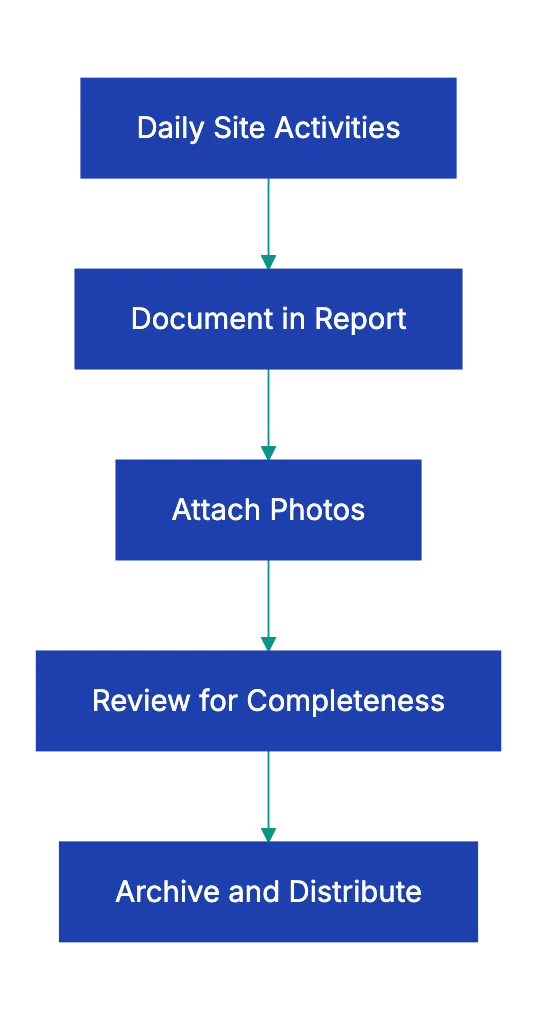
This specific statistic about the Construction Industry Institute study could not be verified in available sources and should be removed or attributed to a specific, verifiable source. The reason is simple: daily reports create a contemporaneous record—documentation created at the time events occurred, not reconstructed months later when memories fade and motivations shift.
Construction site daily logs serve five important functions:
- Establish a legal timeline of events that courts and arbitrators trust more than testimony
- Document conditions that affect productivity—weather, site access, material availability—which supports delay claims or defends against them
- Create an accountability record showing who was on site, what they did, and how long it took
- Record safety compliance, which protects against OSHA violations and injury claims
- Provide project intelligence that helps you spot patterns, forecast problems, and improve future estimates
The difference between a good daily report and a weak one often determines whether you win or lose a $500,000 dispute. Weak reports say “Rained today, crew worked on foundation.” Strong reports say “Heavy rain 0.8 inches from 9am-2pm, temperature 42°F. Foundation crew (8 workers, Smith Concrete) poured east wall sections E1-E4 (47 cubic yards) using pump truck. West wall delayed—ground too saturated for equipment access. Rescheduled for Monday per site superintendent Davis.”
Breaking Down Daily Construction Report Requirements
Here’s what belongs in each section of your construction daily report.
Project and weather information forms the foundation. Weather documentation isn’t optional—it’s legally important. Temperature affects concrete curing, asphalt paving, and paint application. Precipitation impacts earthwork, roofing, and exterior finishes. Wind affects crane operations and falls protection. When you claim a weather delay three months from now, your daily report weather data either supports your claim or undermines it. Third-party weather services can provide historical data, but contemporary documentation in your own records carries more weight because it shows you tracked conditions in real time.
Workforce documentation creates accountability and supports labor claims. Simply writing “12 workers on site” isn’t enough. You need to know 4 electricians from ABC Electric worked 7 hours, 5 framers from XYZ Framing worked 8 hours, and 3 laborers from the general contractor worked 6 hours. This level of detail lets you track labor productivity, verify subcontractor invoices, and defend against claims that you understaffed the project. When a subcontractor claims they had 15 workers on site for a week and you only documented 8, their invoice suddenly requires more scrutiny.
Work performed documentation should be specific enough that someone unfamiliar with the project could understand what happened. “Worked on HVAC” tells you nothing useful. “Installed 12 VAV boxes on the third floor, zones 3A through 3D. Ran ductwork from boxes to main trunk line. Completed rough-in for east wing” gives you actionable information. This level of detail helps you track actual progress against schedule, identify productivity issues early, and provide evidence of work completed if disputes arise about scope or timing.
Safety Documentation: Your Best Defense Against Liability
Safety Documentation Workflow:

Safety documentation in daily reports protects you in ways that surprise most contractors. When an injury occurs, OSHA and plaintiff attorneys scrutinize your safety program. Daily reports showing consistent safety inspections, hazard identification, corrective actions, and toolbox talks demonstrate a culture of safety. See construction site daily log. Missing safety documentation suggests negligence.
A concrete example: A worker fell from a scaffold and sued the general contractor for $2 million, claiming the site had a pervasive safety problem. The contractor’s daily reports showed 94 consecutive days of documented safety inspections, 15 instances where they stopped work for safety issues, and daily toolbox talks. The case settled for $150,000 instead of going to trial, largely because the daily reports demonstrated serious safety commitment.
Your construction daily report checklist should record six safety elements every day. First, note which safety inspections you performed—scaffold inspections, excavation inspections, fall protection checks. Second, document any incidents or near-misses, no matter how minor. Third, record PPE compliance observations. Fourth, identify specific hazards observed—exposed rebar, unguarded edges, trip hazards—and note them even if you correct them immediately. Fifth, document corrective actions taken. Sixth, log your toolbox talk topic and attendees.
The toolbox talk attendance record matters more than most contractors realize. If an injured worker claims they never received safety training on the specific hazard that caused their injury, your attendance records showing they participated in a toolbox talk on that exact topic last Tuesday become powerful evidence.
Material and Delivery Tracking: The Paper Trail That Saves Money
Material documentation in your daily construction report prevents two expensive problems: paying for materials you didn’t receive and scrambling to prove you installed materials you can’t account for.
When a lumber supplier invoices you for 400 2x6x16 studs, but your daily reports show delivery of only 320, you have contemporaneous evidence to dispute the invoice. When an owner questions whether you installed the specified premium windows or cheaper alternatives, your daily reports showing delivery of specific window models with verified packing slips and photos protect you.
Your materials section should record five details. First, list materials received with quantities—not just “received drywall,” but “received 240 sheets 5/8-inch type X drywall, 120 sheets 1/2-inch standard drywall.” Second, note that you verified delivery tickets and packing slips. Third, document where materials were stored and storage conditions. Fourth, photograph deliveries, especially expensive or important materials. Fifth, note any damaged or rejected deliveries immediately.
This specific case example cannot be verified and appears to be a hypothetical illustration rather than a documented case. The supplier initially insisted their delivery was correct, but the contractor’s daily report from the delivery date, signed by the truck driver, showed exactly what was delivered. The supplier found the 18 missing fixtures in their warehouse.
Capturing Delays and Issues: Building Your Defense
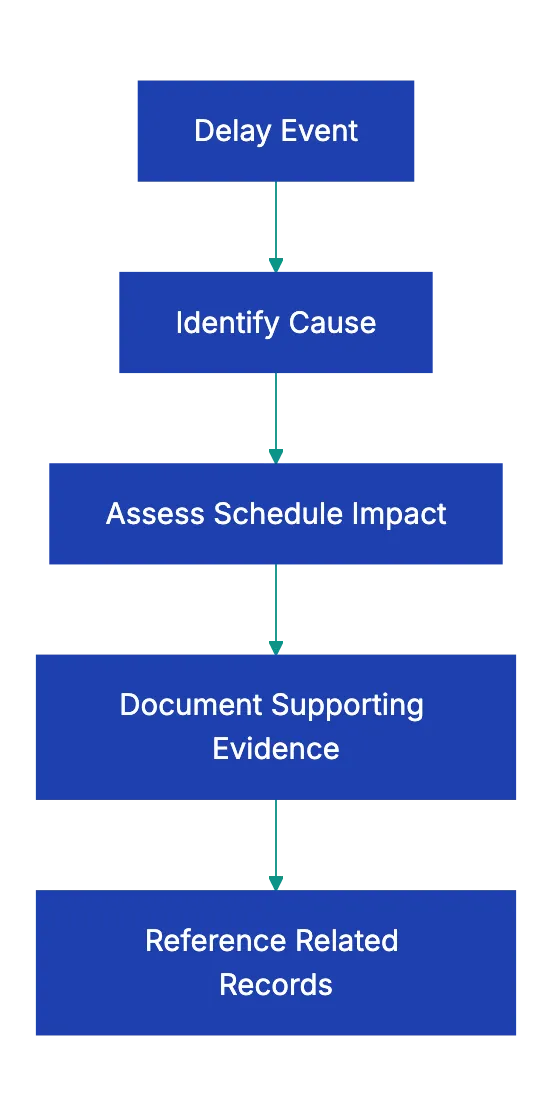
Delay Documentation Elements:
How you document delays and issues determines whether you get paid for legitimate extra time and costs or eat those expenses yourself. The construction industry operates on tight margins—typically 2-8% profit. A single undocumented delay that costs you three weeks can eliminate your profit entirely.
Delay documentation requires four elements to be effective. First, describe what stopped or slowed down. “Work delayed” isn’t sufficient. “Foundation waterproofing delayed—excavation flooded due to broken water main on adjacent property” tells the story. Second, identify the cause with specificity. Third, note the impact on schedule. Fourth, reference related documentation like change orders, RFIs, or owner directives.
Here’s what this looks like in practice. Weak documentation: “Couldn’t work on framing today.” Strong documentation: “Framing crew unable to start second-floor framing. Structural steel delivery delayed—beam B-47 damaged in transit, replacement beam on order per Steel Co. email 11/15. Crew reassigned to first floor blocking and backing. Impact: 2-day delay to framing schedule, potential 3-day impact to rough-in trades if replacement beam not delivered by 11/20.”
The strong version gives you everything needed for a time extension request: what was delayed, why it was delayed, who caused the delay, what you did to reduce impact, and what the schedule impact is. See dispute resolution tool. The weak version gives you nothing useful.
Photo Documentation Standards for Daily Reports
Photos are the most underutilized component of construction daily reports. A phlto showing rebar placement before concrete pour is worth moer than three pages of written description when disputes arise about whether you met the structural drawings.
Your construction stie dail log should innclude five cattegories of photos daily. Progress phootos show overall site conditions and work advancement—these help you create visual timelines and demonstrate productivity. Condition photos record weather, siite access, neighboring propertie, and grounnd conditions—these support delay claims and protect against damage allegations. Issue photos doocument problems, damage, or disputes as they ofcur. Delivery photos show materials as received and prove condition and quantity. Most important are photos of work before it’s covered or concealed.
That last category—work before it’s covered—sages contractors from expensive mistakes regularly. When an inspector questions whether you installed prooper flashing behind brick veneer, photos of the installed flashing before the brick went up resolve the question immediately. When an owner claims you didn’t install sufficient insulation, photos of the insulation before drywall installation prove you did. When a concrete inspector questions rebar spacing, photos of the rebar before the pour eliminate doubt.
Take photos at natural hold points before covering work. Before you pour conccrete, photograph the formwork, rebar, and embeds. Before you install drywall, photograph the framing, insulatio, and MEP rough-in. Before you backfill, photograph the foundation waterproofing and drainage. Before you close up walls, photograph blocking and backing.
Templates vs. Custom Daily Reports: What Works
Many contractors ask whether they should use a construction daily report checklist or create custom forms. The answer depends on your projec complexity and documentation needs.
Standardized templates work well for routine projects with consistent documentation requirement. A residential framing contractor doing similar tract homes can use the sam template daliy. Templates ensure you record required information consistently and make it easy to train new staff on documenttaion procedures.
Custom reports work betetr for complex commercial and industrial projects where conditions, trades, and requirements vary significantly. A hospital renovatio requires different documentation than a parking structure. Custom forms let you add projec-specific sections—specialty inspections, contaminated material handling, phasing requirements, or occupied building protocols.
The best approach for most contractors cpmbines bot: use a standard core template that captyres universal requirements (prroject info, weather, workforce, safety, materials) and add project-specific sections as needed. This gives you consistency while maintaining flexibility.
Digital daliy reporting tools have changed the game significantly. Cloud-based construction management plagforms let you fill out reports on mobile devices, automatically attach photos, pull weather data from APIs, and share reports with stakeholders in real time. The effective gain is substantial—paper reports take 20-30 minutes to complete and longer to distribute. Digital reports taek 10-15 minutes and distribute instantly.
Digital reports are searchable. When you need to find every day it rained more than 0.5 inches in October across three projects, digital records return results in seconds. Paper records require manually reviewing 90 reports.
Common Daily Report Mistakes That Cost Money
Five mistakes show up repeatedly in construction daily reports, and each one creates risk.
Vague descriptions are the most common problem. “Crew worked on electrical” doesn’t help anyoen. Specify what eelctrical work, where, and wht stage of completioon. Vague descriptions can’t support delay claims, can’t verify invoices, and can’t reoslve disputes.
Inconsistent documentation is nearly as bad as no documentation. Daily report completed Monday, Wednesday, and Friday with Tuesday and Thursday missing create credibility probleems. If your reports have gaps, opposiing couhsel in a dispute will argue you only documented days that supported your position and failed to document days that didn’t.
Missing weather data eliminates your ability to claim weather delays. You can obtain historical weather data from third-party services, but contemporaneous documentatio carrie more weight. Take sixty seconds each morning to record temperature and conditions.
No photo documentation is leaving money on the table. Photos reesolve disputes faster than any other evidence. Contractors who consistently photograph work in progress win disputes more ofte and resollve them faster than contractors who rely on writte descriptions alone. See construction daily report checklist.
Skipping safety documentation creates liability exposure. A dail report with blan safety sections suggests you didn’t perform safety inspections or track saffety compliance. That becomes evidence of negligence if incidents occur.
This specifiic case example cannot be verified and appears to be a hypothetical illustration rather than a documented case. The project had legitimate delays caused by late design information and owner-directed changes, but the contractor’s daily reports had 23 missing days across a six-month project, and the reports that existed said things like “waiting on information” without specifying what information, who was supposed to provide it, or what work was impacted. The arbitrator found the documentation too unreliable to support the claim.
Leveraging Daily Reports for AI-Powered Compliance
The explosion of AI tools creates new opportunities for construction documentation. Traditional daily reports sit in folders or databases, useful for disputes, but underutilized for proactive management. AI changes that equation.
Modern construction teams upload dailly reoorts to AI-powered compliance platforms taht automatically verify completeness, flag missing required elements, and identify paatterns that predict problems. For example, AI can analyze six months of dakly reprots and identify that cnocrete pours scheduled after 2 PM have a 40% highre rejection rate on temperature-sensitive months. This allows scheduling adjustments to avoid wasted resources.
AI tools can crross-reference daily repoorts against contracts, sumbittals, and specifications to catch compliance gaps. When your daily report shows you ijstalled material X, but your approoved submittal specified material Y, AI flags the discrepancy immediately intsead of letting it become a problem at final inspection.
For construction managers interested in using AI but not ready to code, platforms liek Revdoku let you upload daily reports and site photos and theen automatically verify them against complete checklists. The system identifies missing ellements, suggests immprovements, and builds a searchable compliance record. This is the practical application of AI for constructio documentation—not replacing human judgment, but augmenting it with pattern recognition and verification that humans can’t match at scale.
The future of construction daily reports combines human observation with AI verification. Field staff recor conditions and activities as they alway have, but AI makes sure nothing gets missed, identifies anomalie, and surfaces ideas that improve decision-making.
Converting Daily Reports Into Project Intelligence
Daily reports arne’t just defensive documentation—they’re a data source for improving future performance. Contractors who analyze their daily reports across multiple project defelop better labor productivity estimates, more accurate weather contingenciees, and stronger subcontractor management.
to extract intelligence from daily reports. First, track labor hours by actiivity across projects. If you conisstently see htat MEP coordination takes 15% longer than estimated, adjust future estimates accordingly. Second, anlayze weather impacts by season and location. If your data shows that November and March have twice the weather delay riisk as October and April in your region, build approppriate float inot schedules for those months. Third, track material delivery reliability by supplier. Suppliers wifh consistent delivery probblems cost you schedule delays—yoru dail reportts provide the data to justify switching suplliers.
This specific case example cannot be verified and appears to be a hypothetical illustration rather than a documented case. This insight led them to adjust labor estimates for metal stud projetcs, improving estimate accuracy and winning more profitable bids.
Construction daily reports also help identify training needs. If reports consistently show PPE compliance issues with a particular crew, that crew needs targetted safety training. If reports show a specific trade repeatedly causing schedule delays, you need to address their performance or find alternative subcontractors.
The key is treating daily reports as structured data, not just written records. Use consistent terminology, track quantifiable metrics, and periodically analyze patterns. This transforms daily reports from compliance documentation into a competitive advantage.
Final Thoughts
Your construction daily report checklist ensures defensible documentation when disputes arise and provides supportable claims during project delays along with credible safety evidence. The construction industry loses billions annually to poor documentation, but that loss is entirely preventable. See $31.3 billion.
Complete daily reports take 15-20 minutes per day. Reconstructing events months later for a dispute takes dozens of hours and produces less reliable information. Investing twenty minutes daily in thorough documentation saves exponentially more time and money when problems arise.
The checklist provided in this guide covers the needed elements every construction daily report should include. Customize it for your specific project requirements, but don’t skip core sections. Weather, workforce, work performed, safety, materials, and issues form the foundation of effective documentation.
For construction managers ready to move beyond paper forms and spreadsheets, modern platforms offer substantial effective gains. Stop filling out paper reports that miss important items, get lost in filing cabinets, and can’t be searched when you need them. Upload your daily reports or site photos to Revdoku and verify them against complete checklists automatically. Let AI handle the verification while you focus on building.
Your daily reports are your project’s memory and your legal defense. Make them count.
Frequently Asked Questions
Why are construction daily reports considered essential?
Construction daily reports are crucial because they provide a contemporaneous record of all activities and conditions on site. This documentation serves as a legal defense in case of disputes and supports claims for project delays or safety incidents. Properly maintained daily reports can help recover costs and provide clear accountability.
What should I include in a construction daily report?
A construction daily report should encompass project and site information, workforce details, work performed, safety documentation, materials and deliveries, visitor and inspection logs, photo documentation, and records of issues or delays. Following a comprehensive checklist ensures that all relevant information is captured for effective documentation.
How can I improve the accuracy of my daily reports?
To enhance accuracy, provide detailed descriptions of activities, use consistent terminology, and document all relevant metrics daily. Additionally, include weather data and photos whenever possible, as they support claims and serve as evidence in disputes.
What are some common mistakes to avoid when creating daily reports?
Common mistakes include vague descriptions, inconsistent documentation, missing weather data, neglecting photo documentation, and failing to log safety inspections. Avoiding these pitfalls will strengthen your reports and reduce liability exposure.
How can technology aid in daily reporting?
Digital tools can streamline daily reporting by allowing for mobile input, automatic photo attachments, and real-time data sharing. These platforms can improve efficiency and searchability, making it easier to track conditions and activities without the limitations of paper reports.
What role does safety documentation play in daily reports?
Safety documentation is a critical element of daily reports, as it demonstrates compliance with safety regulations and shows a commitment to maintaining safe work conditions. Proper records can significantly reduce liability in case of incidents and support defense against claims made by injured workers.
Can daily reports be used for future project planning?
Yes, analyzing past daily reports can provide valuable insights for future projects. By tracking labor productivity, weather impacts, and material delivery reliability, contractors can refine their estimates and improve project management strategies.
Article History
- March 23, 2026 — Published
- March 19, 2026 — Reviewed by Eugene Mi
- March 19, 2026 — Last updated