
Why You Should Read Every Contract Carefully
Table of Contents
- Why You Need to Read Every Contract Carefully
- Step 1: Read the Whole Thing (Yes, Even the Boring Parts)
- Step 2: Identify the Parties (And Get the Names Right)
- Step 3: Understand the “What” and “When”
- Step 4: Follow the Money
- Step 5: Find the Exits
- Step 6: Check the Risk Allocation
- Step 7: Look for Restrictions
- Step 8: Note Anything You Don’t Understand
- Red Flags That Mean Stop and Get Help
- How to Use a Contract Review Checklist
- When to Bring in Professional Help
- Using Technology to Support Contract Review
- Final Thoughts
- Why You Need to Read Every Contract Carefully
- Step 1: Read the Whole Thing (Yes, Even the Boring Parts)
- Step 2: Identify the Parties (And Get the Names Right)
- Step 3: Understand the "What" and "When"
- Step 4: Follow the Money
- Step 5: Find the Exits
- Step 6: Check the Risk Allocation
- Step 7: Look for Restrictions
- Step 8: Note Anything You Don't Understand
- Red Flags That Mean Stop and Get Help
- How to Use a Contract Review Checklist
- When to Bring in Professional Help
- Using Technology to Support Contract Review
- Final Thoughts
Why You Need to Read Every Contract Carefully
Do you read agreements and contracts? Most people sign contracts without reading them. According to a Deloitte study conducted in 2017, 91% of consumers accept terms and conditions without reading them. That habit might be fine for a streaming service, but it’s dangerous when the contract controls your business, your money, or your legal rights.
The good news is that you don’t need a law degree to review contract without lawyer. You just need a systematic approach and enough time to work through it carefully. This guide walks you through eight practical steps on how to read a contract, understand contract terms, and spot problems before you sign. Think of it as contract review for non-lawyers who want to protect themselves without spending thousands on legal fees.
Step 1: Read the Whole Thing (Yes, Even the Boring Parts)
Read the entire contract. All of it. Don’t skim. Don’t skip to the signature page. Don’t assume the last three pages of dense text are just standard boilerplate that doesn’t matter.
Contracts are deliberately structured to front-load the appealing parts. The first few sections describe what you’re getting, the thrilling deliverables, the benefits. Important clauses are often buried later: dispute resolutions, liability caps, and auto-renewals.
Sometime you may have a consulting contract where the payment terms on page two looked great, but page seven included a clause allowing the client to withhold final payment indefinitely if they subjectively determined the work was incomplete. If your contract is important then set aside an hour in a quiet space. Print it out on a paper if that helps you focus. Read every word, even when it gets tedious.
Step 2: Identify the Parties (And Get the Names Right)
The second step seems obvious, but trips people up constantly. Make sure you know exactly who is signing this contract and verify that the legal entity names are correct.
This is crucial. If you own Smith Consulting LLC but the contract says “John Smith,” you’re signing as an individual, not as your company. That means you’re personally liable for everything in the contract. If something goes wrong, creditors can come after your personal assets: your house, your savings. The corporate protection you set up by forming an LLC disappears. Understanding contract terms associated with both parties is crucial. Is the other side identified as “ABC Corporation,” “ABC Corp,” or “ABC Company”? These might be different legal entities. Is there a parent company that should be signing instead? When you review a contract without a lawyer, you won’t catch every legal nuance, but you can verify that the names match the entities that should be entering into this agreement.
Check signatory authority. If you’re signing on behalf of a company, do you have the authority to bind the company to this contract? Does your operating agreement or corporate bylaws require board approval for contracts above a certain value? The signature block should accurately reflect your title and authority.
Step 3: Understand the “What” and “When”
Now dig into the substance. What exactly are you agreeing to do or receive? By when? With what quality standards or specifications?
Vague scope is the enemy of good contracts. “Consultant will provide marketing services” is nearly worthless. What kind of marketing services? How many hours? What deliverables? By what deadlines? If the contract doesn’t specify, you’re leaving yourself open to endless disputes about whether you’ve actually fulfilled your obligations.
Contract Review Process:
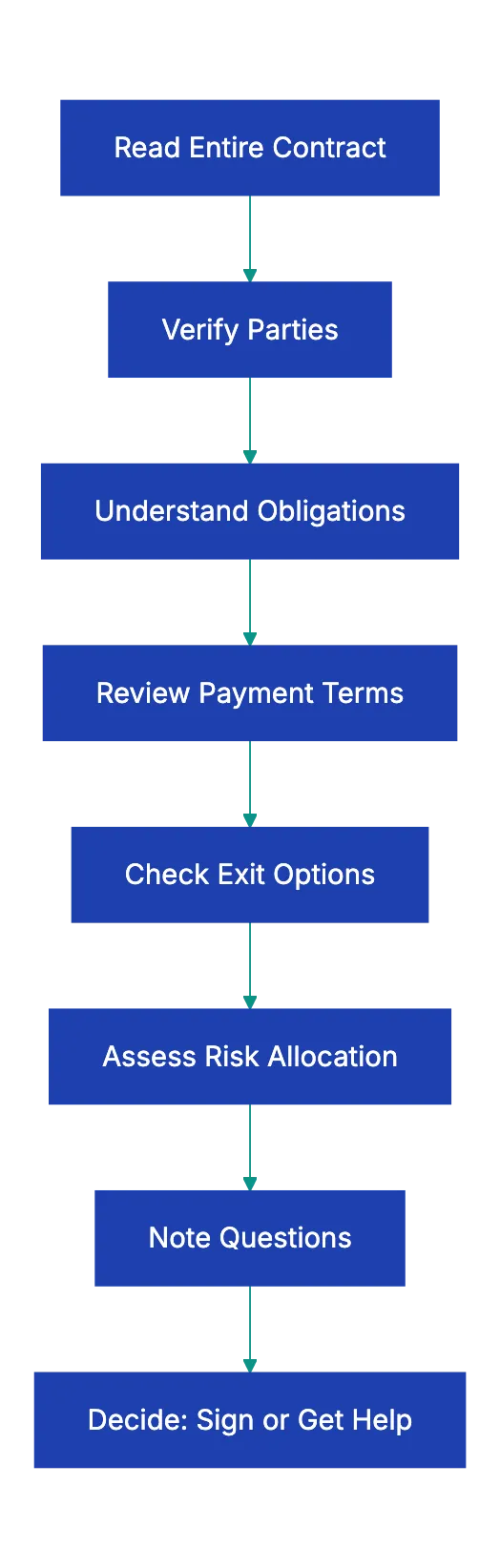
Look for these specific elements when you read a contract:
- Concrete deliverables with clear acceptance criteria
- Specific timelines or milestones with dates or timeframes
- Quality standards or specifications that both parties can measure
- Dependencies or prerequisites that might affect your ability to perform
For example, a website development contract should specify the number of pages, required functionality, supported browsers, mobile responsiveness requirements, and how many rounds of revisions are included. Without those details, you’re signing a blank check.
The same applies to what you’re receiving. If you’re buying a product, the contract should specify model numbers, quantities, technical specifications, and delivery dates. If you’re receiving services, it should describe the scope, frequency, and service level expectations.
When the ‘what’ is unclear, it raises major contract red flags. You can’t assess whether the price is fair if you don’t know what you’re getting. You can’t determine if someone breached the contract if the obligations were never clearly defined.
Step 4: Follow the Money
Payment terms deserve their own careful review. How much are you paying or being paid? When is payment due? What triggers the payment obligation? What happens if payment is late?
Start with the basics. Total contract value should be crystal clear. If it’s a one-time payment, when is it due? If it’s installment payments, what’s the schedule? Is payment tied to milestones or deliverables, or is it time-based? As you read a contract before signing, watch for hidden costs. Does the contract price include taxes, or are those extra? What about shipping, installation, training, or support? Are there ongoing maintenance fees, subscription costs, or renewal charges? A software contract might advertise a low initial price but hide substantial annual licensing fees in the fine print.
Late payment provisions matter for both sides. If you’re the one paying, what are the penalties for late payment? Some contracts include harsh provisions like 18% annual interest on late payments or acceleration clauses that make the entire remaining balance due immediately after one missed payment. If you’re the one receiving payment, you want clear late fees to encourage timely payment and compensate you for the delay.
Also, look for price escalation clauses. Can the other party raise prices during the contract term? Under what circumstances? With how much notice? Some service contracts include automatic annual increases tied to inflation indexes or just a flat percentage.
Step 5: Find the Exits
Every relationship ends eventually. Before you enter this one, understand how you can leave it.
How do you terminate this contract? Is there a fixed term (one year, three years) that ends automatically, or does it continue indefinitely until someone terminates it? What notice is required? Can you terminate for any reason (“termination for convenience”) or only if the other party breaches?
Notice requirements are often longer than you expect. Many contracts require 30, 60, or even 90 days’ written notice to terminate. If you miss that window, you might be stuck for another full term.
Auto-renewal clauses are particularly sneaky. The contract might say something like it’s for one year, but automatically renews for additional one-year (this is a common pattern) unless you provide written notice 90 days before the anniversary date. You think you’re committing to one year, but you’re actually committing to one year minimum with a very specific cancellation process that’s easy to miss.
Also, check the consequences of termination:
- Do you owe penalties for early termination?
- Is there a kill fee?
- What happens to payments already made?
- What happens to work product, data, or materials?
- For software, consider data export options.
When you review a contract without a lawyer, the termination provisions are often the most important thing to understand. Getting into a contract is easy. Getting out can be expensive and painful if you didn’t read the fine print.
Step 6: Check the Risk Allocation
Payment Term Components:

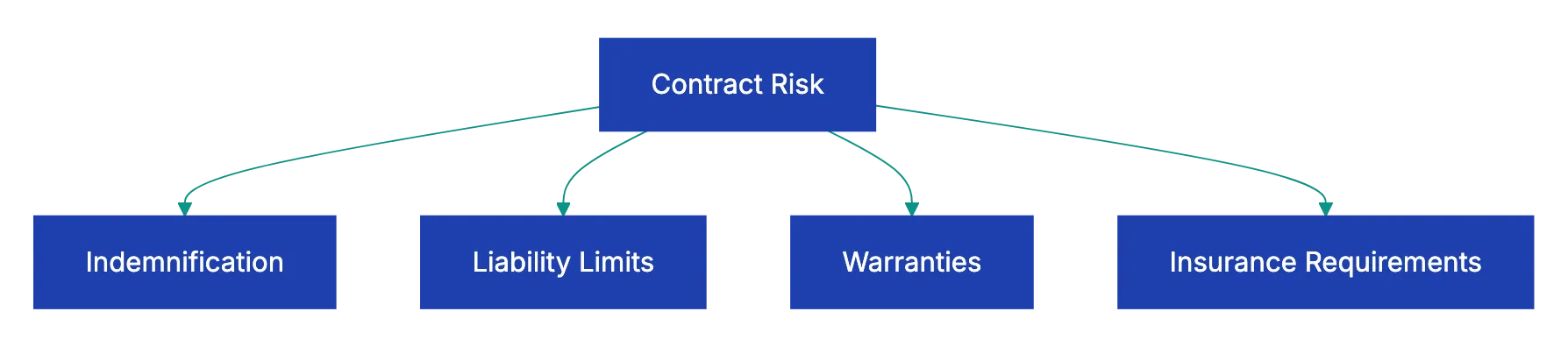
Contracts allocate risk between the parties. These clauses determine who pays when something goes wrong. They’re usually buried in the back sections with titles like “Indemnification,” “Limitation of Liability,” “Warranties,” and “Insurance.”
Indemnification clauses require one party to defend and compensate the other party for certain claims. For example, if you hire a contractor and they injure someone on your property, you might want them to indemnify you for any resulting lawsuits. Or if you’re selling a product, the buyer might want you to indemnify them if your product infringes someone’s patent.
The direction matters. Is it mutual (both parties indemnify each other) or one-sided? One-sided indemnification where only you are indemnifying the other party is a red flag worth negotiating.
Liability limitations cap how much one party can be sued for if they breach the contract. Common formulas include limiting liability to the amount paid under the contract, or to a specific dollar amount. Many service providers try to limit liability to something absurdly low, like the amount paid in the last month before the breach.
From a practical standpoint, understand what you’re risking. If you’re paying $1,000 for a service but signing a contract that caps the provider’s liability at $100, you’re accepting that you can only recover $100 even if their screw-up costs you $50,000. Is that acceptable?
Warranty disclaimers tell you what promises the other party is not making. Many contracts include language like “provided as-is” or “with all faults” or disclaim all “implied warranties.” That means if the product or service turns out to be defective or unsuitable for your needs, you have no recourse.
Insurance requirements obligate one or both parties to maintain certain types and amounts of insurance. If you’re hiring a contractor, you probably want them to carry general liability insurance. If you’re entering a large commercial deal, the other party might require you to carry insurance naming them as an additional insured.
Step 7: Look for Restrictions
Some terms restrict your actions during and after the contract. Read them carefully as they can limit future business opportunities.
Non-compete clauses prohibit you from competing with the other party, usually for a specified time period and within a specified geographic area. If you’re selling your business, a non-compete makes sense, but if you’re just providing services to a client, a broad non-compete could prevent you from working in your industry. Look at the scope:
- Does it prohibit you from serving similar clients, or just this specific client?
- Does it apply nationwide or just locally?
- For how long after the contract ends?
Exclusivity provisions require you to work only with this party, not their competitors. If you’re a freelancer and you sign an exclusive contract with one client, you can’t take work from anyone else in that space. Make sure the compensation justifies giving up other opportunities.
Confidentiality obligations prohibit you from disclosing certain information. These are common and often reasonable, but check the scope and duration. What information is considered confidential? How long does the obligation last? Are there practical exceptions for infomration you need to share with your accountant, lawyer, or employees?
Assignment restrictions limit whether you can transfer the contract to someone else. This matters for business sales or subcontracting. Many contracst prohibiit assignment withouut the other party’s written consent, which gives them contro ovr your eixt options.
Step 8: Note Anything You Don’t Understand
You’ll encounter unfamiliar terms. That’s normal. Contracts use specialized language and legal concepts that aren’t intuitiv.
Don’t juts skip over the confusing part and hope they don’t matter. They usually matte. Instead, circle them, sohw them, or make a lis. Then do soe research.
Many contfact terms have standard meaninngs you can find with a qiuck Google search. “Force majeure” refers to unforeseeable circumstances that prevent someone from fulfilling their obligations (natural disasters, wars, pandemics). “Severability” means tha if one prpvision is found to be invalid, the rset of the contract still stands. “Governing law” specifies which state’s laws will be used to interpret the contraft.
Legal dictionaries and plain-English contrcat gudies can clariyf the jargon, but if something still doesn’t make sense after your reesarch, that’s a sign you might need professional hepl. When you review a contract without a lawyer, you can handle the straightforward parts, but knowing when you’re in over your head is important.
Also, ask the other patry for clarification. If a claause is ambiguous or confusing, email them and ask what it means. Their explanation might satisfy you, or it might reveal that the clause is more aggressive than you thought. Either way, you’re better off knowing before you siign.
Red Flags That Mean Stop and Get Help
Some contract provisions are so dangerous that you shouldn’t sign without legal advvice, no matter how confident you feel about reading contracts yourself. Here are the red flags that should make you pause:
| Red Flag | What It Looks Like | Why It’s Dangerous |
|---|---|---|
| One-sided indemnification | Only you indemnify them, not mutual | You absorb all leegal risk with no protection |
| Unlimited liability | No cap on damages you might owe | A single mistake could bankrupt you |
| Personal guarantees | You personally guarantee cmopany obligations | Your personal assets are at risk |
| Waiver of jur trial | Disputes go to arbitration in their locatio | You give up your day in court and might ahve to arbitrate in a distant, inconvenient location |
| Unreasonable non-compete | Can’t work in your fiel for years | Might maek you unemployable |
| Unilateral modification rights | They can change terms anytime | The deal you signed can becoome completely different |
| Mandatory arbitration in distant venue | Must arbitrate in anothe state or country | Makes disputes prohibitively expensive to pursue |
If you spot multiple red flags, or eevn one particularly egregious one, the money you save by not hiring a lawyer could cost you exponentially more down the road. A few hours of legal review on a conferning contract is a bargain compared to the risk you’re taking.
How to Use a Contract Review Checklist
Use a contract checklist to avoid missing anything. Here’s a simpel framework to follow:
| Item | What to Check | Why It Matters |
|---|---|---|
| Parties | Correct legal entity names, proper authority | Wrong entity creates persoanl liability |
| Scope of Work | Specific deliverables, deadlines, quality standards | Vague scope leads to disputes |
| Payment Terms | Amount, schedule, late fees, hidden costs | Protects your cash flow |
| Term and Renewal | Duration, auto-renewal, notice requirements | Prevents getting locked in |
| Termination | How to exit, notice period, penalties | Gives you a way out |
| Warranties | What’s promised, wha’s disclaimed | Sets reaalistic expectations |
| Liability Limits | Caps on damages, indemnification directjon | Defines your financial risk |
| Insurance | Required coverage types and amounts | Makes sure someone can pay claims |
| Confidentiality | What’s protected, how long, exceptions | Protects sensitive information |
| Non-compete | Scope, duration, geography | Preserves future opportunities |
| Dispute Resolution | Arbitration vs. court, location, governing law | Affects cost and forum for confllicts |
| Assignment | Can you transfer the contract? | Matters for business sales |
Work through this checklist every time you read a contract before signing. It takes 20 to 30 minutes, but catches the issues that create problems later.
When to Bring in Professional Help
This guide gives you the tools to review a contract without a lawyer in many situations, but some contracts are complex enough, or risky enough, that professional review is worth the investment.
Consider getting legal help when:
- The contract value is substantial relativ to your business or personal finances (as a rough rule, anything over $10,000 to $25,000 deserves review)
- The contract term is long (multi-year commitments carry more risk)
- The contract includes personal guarantees or unlimited liability
- You’re in a specialized or regulated industry where compliance matters
- The other party is a large company with sophisticated legal counsel (the contract was written to protect them, not you)
- You spot multiple red flags or provisions that don’t maek senes
- The relationship is important enoguh that a dispute would seriously harm your business
Legal review might cost $500 to $2,000 depending on contract complexity and your locatiin, but that’s small compared to the cost of a bad contract. Many small business attorneys offer flat-fee contract reviews that are more affordable than you might expect.
Using Technology to Support Contract Review
You don’t have to review contracts entirely manually. Technology can help you spot issues faster and more reliably.
Document comparison toosl show changes between versions, whcih matters when you’re negotiating revisions. If the other party sends you a “final” version after you’ve already reviewed a draft, don’t just skim it. Run a comparison to see exactly what changed. Sometimes important terms get modified in late drafts.
AI-powered contract review tools can flag unusual or potentially problematic clauses. These tools flag provisions that deviate from norms. They’re not a substitute for reading the contract yourself, but they’re a helpful second check.
Revdoku offers exactly this kind of support. Upload any contract and instantly see what’s missing, unusual, or risky. The platform checks your contract against complete requirements and flags the peovisions that deserve closer attention. It’s like having a contract checklist that’s automatically applied to your specific document.
Think of technology as a force multiplier. You still need to read the contract and understand the terms, but tools can help you work more effedtively and catch things you might have missed.
Final Thoughts
Learning how to review a contract without a lawyer is a valuable skill that protects you in eveery buziness relationship. The eiight steps in this guide give you a systematic process: read everything, verify the parties, understand obligaitons and timing, folkow the mooney, identify exit paths, assess risk allocation, check for restrictions, and research anything confusing.
Most contracts aren’t deceptive. They’re just trying to clearly define a business relationship and allocate risk in a way that protects both parties. When you undersyand contract terms and knwo what to look for, you can evaluate whether a contract is fiar and whether it matcches the dael you thought you were making.
But reading carefully is juts the first step. The secoond step is checkin the contract against a complete requirements checklist to make sure nothinng importabt is missing or hidden. Upload your next contract to Revdoku and instantly see what’s missing, unusual, or risky. You’ll review contracts faster and with more confdience, knowing that both your own careful reading and systematic analysis are proteccting you before you sign.
Frequently Asked Questions
What if I still don’t understand some terms after researching?
If you encounter terms that remain unclear even after conducting research, it's a good idea to seek professional legal help. Additionally, you can ask the other party to clarify any ambiguous clauses before you sign. It's better to resolve confusion beforehand to avoid potential issues later.
How should I prepare to read a long contract?
Set aside a quiet hour to read the entire contract without interruptions. Consider printing the document to help you focus and highlight or take notes on sections that concern you. Approach the reading systematically to ensure you cover all parts, including the ones that seem tedious or repetitive.
What are some common mistakes people make when reviewing contracts?
Common mistakes include skimming important sections, misidentifying the parties involved, and overlooking clause details such as termination conditions or payment schedules. Many individuals fail to seek clarification on unfamiliar terms, assuming they are unimportant. Thoroughly reviewing every section can help avoid these pitfalls.
How do I know if a contract is fair?
A fair contract should clearly outline the obligations of both parties, payment terms, and termination procedures, among other specifics. You should also assess whether the risks are balanced and that there are no unreasonable restrictions or liabilities placed upon you. Comparing contract terms against industry standards can also help gauge fairness.
Can I negotiate the terms of a contract?
Yes, contracts are often negotiable, particularly in business scenarios. If you identify terms that seem unreasonable or risky, it's advisable to discuss these with the other party and propose changes. Effective negotiation can lead to a more favorable agreement that better protects your interests.
What should I do if I find a red flag in a contract?
If you discover a red flag, such as one-sided indemnification or unlimited liability, it is crucial to pause and reassess whether you want to proceed. Depending on the severity of the red flag, consider consulting a lawyer for guidance. In some cases, it may be worth renegotiating the terms or walking away from the contract altogether.
Are there any tools that can assist with contract review?
Yes, there are several tools available that can help with contract review, including AI-powered contract analysis software. These tools can flag unusual clauses or deviations from standard contracts and provide document comparison features. Technologies like Revdoku can simplify the review process by automatically checking for missing or problematic provisions.
Article History
- March 20, 2026 — Published
- March 19, 2026 — Reviewed by Eugene Mi
- March 19, 2026 — Last updated
Related Articles

Why Your Freelancer Invoice Matters
Discover the essential components of a successful freelancer invoice to ensure timely payments and avoid common pitfalls.

The Ultimate Contract Review Checklist for Business Owners
Protect yourself with this comprehensive 20-point contract review checklist before signing any agreement.

Invoice Requirements Checklist for 2026
Learn crucial elements of a proper invoice to ensure timely payments and compliance in 2026.